Or how to learn to drive, again
By Guy Thompson
I had been in Germany for just over 24 hours.
I was on my own and wished I had packed a lot lighter as I struggled to pull my luggage off the train while others waited around me. I was glad I hadn’t learned any German curse words yet, which meant I relied solely on my English-language swear words, and that no one around me seemed to understand those particular English words. If they had, I’m sure I would have gotten some pretty dirty looks.
German trains are nothing if not efficient. Like, to the second efficient. This is good and bad. Good in that you always know that they will always, and I mean always, arrive and depart right on time. This is bad if you don’t have your act together. There was no extra time allotted for those kinds of people.
Man, I could have really used some extra time.
I also swore at myself for not packing lighter.
This was my second international trip, and I should have had a better grasp on how to pack for this kind of trip. But, I was also young and fairly in shape. Okay, distance-runner shape and not football player shape. I was going to be on my own for six months and took what I thought I needed. Plus a lot more. The 40 rolls of slide film were a necessity. Camera, of course. (Oh, the number of times since then that I wished I had had a digital camera back then!) Books, in English, naturally. I had a couple of notebooks to write in. Gifts for each family. And loads of things that were apparently so important I have since forgotten what they were and probably should have left them at home. If I were to write a travel book, it could be solely on what not to pack for trips. All of this was crammed into two large suitcases and a backpack that had served as my carry-on. Plus a camera bag.
Back at the National 4-H Center near Washington, D.C., I had even tried to lighten my luggage, but to no avail. I got the feeling that I wasn’t the first outbound IFYE to ask if they happened to have some extra storage space for the next six months. Fine. I’ll just take it all with me, then.
So there I was, shortly before noon on June 13, standing on the platform in the Wiesbaden Hauptbahnhof (Hbf), surrounded by my luggage as I worked to catch my breath. I looked up and down the platform, looking for a sign or something to help me single out my host family from everyone else. A couple of Germans, a boy and a girl who looked close to my age and holding a piece of paper seemed to take an interest in me. I figured they had never seen quite that level of skill in exiting a train with this much luggage before and wanted to ask how I did it. I couldn’t blame them. I wanted to know how I had done it, too.
They walked towards me. I kept an eye on them as I also tried to look for a family that might be seeking a temporary family member from America.
“Guy?” the boy asked, double-checking the paper.
I must admit, I had expected my German family to be older.
This was Holgar Gath, 19, and his cousin, Stefanie, 15. They were here to pick me up and head to Weilburg, which was an hour’s drive north of the station, to the family farm where everyone else was waiting. Reexamining a map later, it occurred to all of us that it would have been a lot easier if they had just driven to the Frankfurt Hbf to pick me up. It would have saved 40 minutes on a train, not to mention the struggle to extricate myself and my luggage from the carriage. A couple of weeks later when it was sadly time for me to leave, the train ticket provided by the Landjϋgen had me leaving from Wiesbaden. The Gaths just drove me to Frankfurt, and I caught the train there.
Holgar and Stefanie asked to help me with my stuff. I thought about telling them I had this. I had, after all, traveled the width of the Atlantic Ocean, fought through Frankfurt airport, on and off buses and trains, up and down stairs in a small hotel, and made it to this platform with my luggage intact and only a few severely pulled muscles. Instead, I graciously accepted their offer and the three of us huffed our way to Holgar’s Volkswagen with half a ton of stuff some crazy American had brought with him. If that car had been a centimeter smaller, we would have left something behind. As it was, we just crammed into the car, luggage and all, and promptly went tearing across the German countryside.
##
I have to say, I really enjoyed that first drive from Wiesbaden to Weilburg as it was my first taste of traveling via autobahn. Pity it wasn’t in a Porsche, but it was still great to be zipping along at 100+ MPH in a Volkswagen Rabbit. Couldn’t do that back in Ohio, though not for a lack of trying.
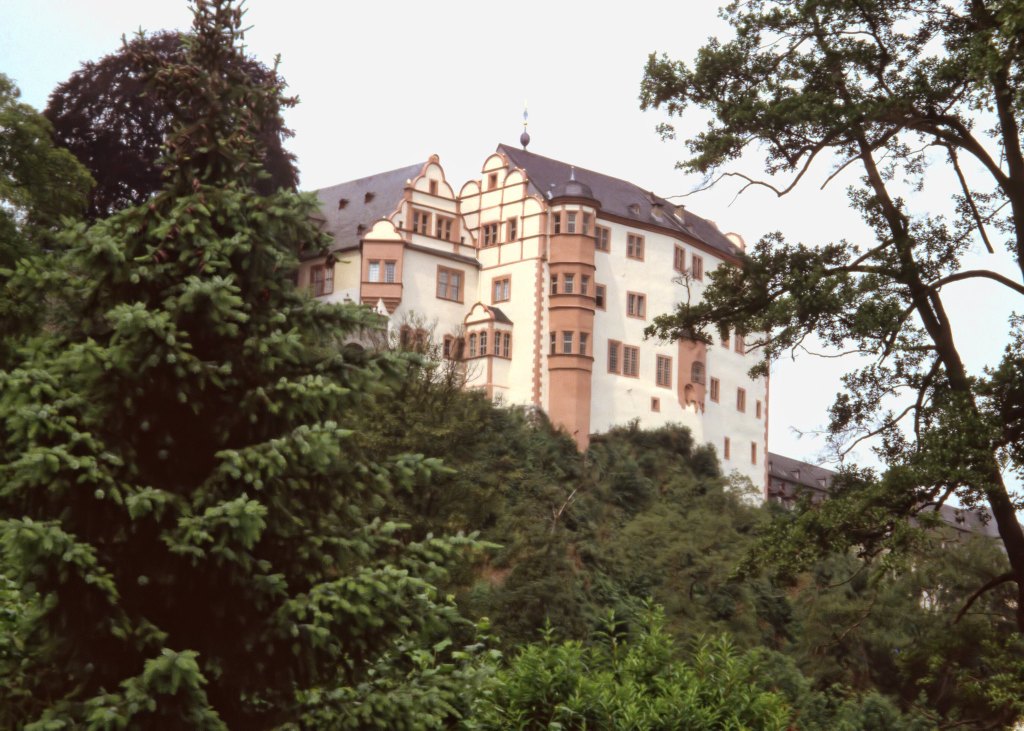
We soon came into the town of Weilburg, a town of about 7,000 that didn’t sit along the Lahn River as much as the Lahn River looped back around and tried to put the center of the town in a chokehold. As we came along the river, Holgar pointed up and to the right, telling me that was the Weilburg Schloβ. I looked up and saw a very nice, very large, very old house sitting high above the river. Schloβ. No idea. But I smiled and nodded to indicate that, yes, I thought it was a genuinely nice schloβ. Probably the best example of one of those I have ever seen.
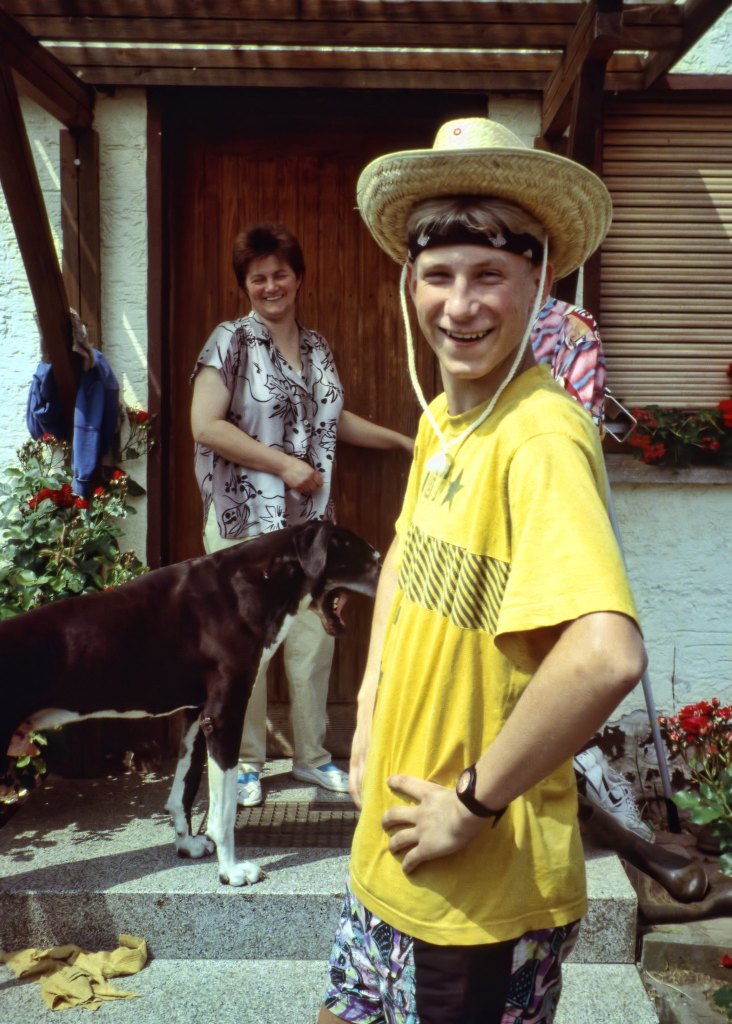
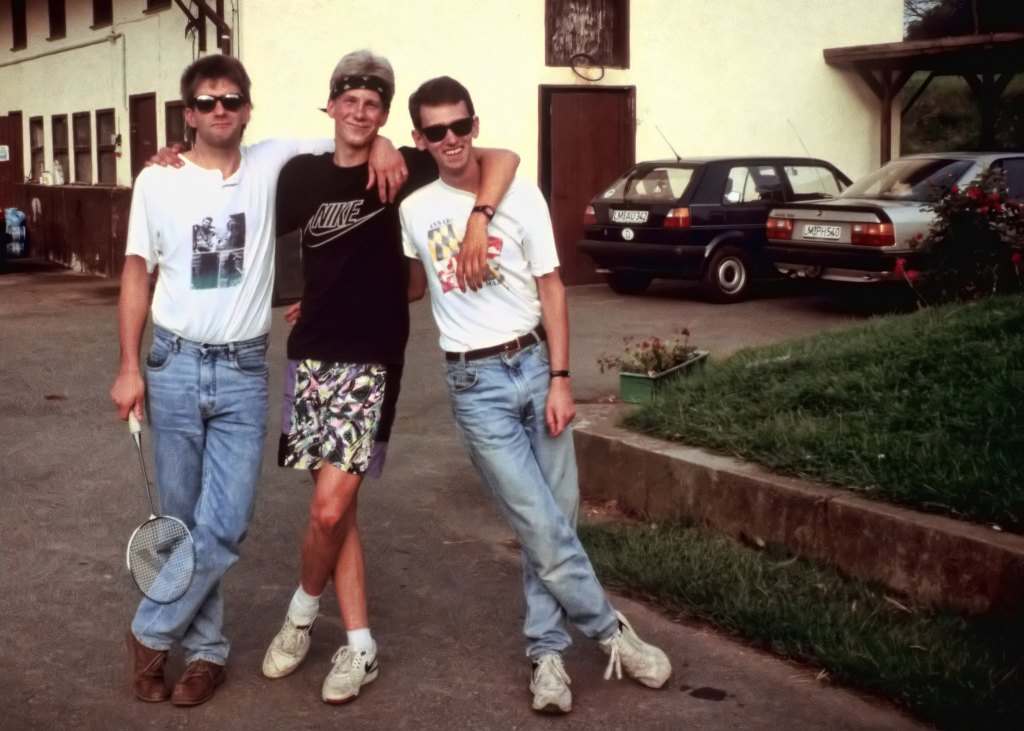
A few turns down the road, and we were suddenly on a single-lane road that dove headlong into some dark woods. It twisted as we climbed up a hill that would have given me a good challenge to run up. A few meters out of the woods and the car snapped to the left and into a driveway. I had arrived at Host Family #1 – The Gaths. In very short order, I was out of the car, along with my luggage (somehow), and being greeted by the rest of the family – host dad Wolfgang, host mom Gerda, and host brothers Rainer, 21, Holgar, and Carsten, 16. Host mom and dad reminded me a lot of some of the parents of my friends in 4-H, particularly those who were on farms. Thick, sturdy, and full of work, inside and out. Rainer and I were the same age, but the difference between Holgar and Carsten in age almost didn’t matter. It didn’t take long for the four of us to hit it off and start goofing around.
Oh, and they had cows. Lots of cows. I was supposed to be learning about agriculture, so I should probably mention that fact.
##
To be honest, I don’t remember a lot from our orientation back at the National 4-H Center. I know we had some. The reality of it was, you get that many college-aged former 4-Hers in one place and the idea of learning anything can just go straight out the window. I think there were some sessions on… Nope. Thought I had it there for a moment.
There was one thing that they did make sure stuck with us as we all spread out across the world that they summed up in two words – culture shock. That is, the shock of being in a different culture and unable to function to the point you don’t want anything to do with the new culture. It was worse than being merely homesick. Homesick was mild compared to a case of full-blown culture shock. You would suddenly hate everything to do with the place you were visiting. The language. The food. The cars. (Except for Porsches. No one could hate those.) The people. Everything.
You did not want to get culture shock as it was the surest way to ruin your experience and ruin it for everyone around you, too. We were there to learn about the culture, not reject it like a piece of rotted fruit. We were to be on high alert for any signs that we might be coming down with culture shock. What, exactly, we were supposed to do if we felt we were coming down with culture shock, I never fully understood. We were supposed to do something. I’m sure of it. Those directions must have been in part of the orientation that we zoned out on.
Even though I had only been there a little over 24 hours, I did not have culture shock at all. I loved the German culture, with a few exceptions, I’ll note from time to time.
Nope. Instead, I would get farming culture shock.
As noted in the previous chapter, I am not a farmer. Visiting a farm and staying with cousins on a farm is nowhere near the same as being an actual farmer.
I think this is an important fact to establish as I was about to spend three weeks, full-time, on a farm. That was going to be a real eye-opener.
##
I had been at the house long enough to have a very nice lunch with everyone and start the impossible task of answering all of the questions they threw at me. They all came to a common realization right away – this American could not speak German to save his life. Even simple things, like asking to pass the salt, would from this point on require a lot of gesturing and pointing on their behalf until I realized what they were after and politely passed them the pepper. Or sugar.
Rainer and Stefanie decided that maybe what I needed to get settled here was some good local culture. So we headed to see the schloβ.
Turns out, schloβ (schloss, for those wondering the English equivalent – I know. That was so helpful.) means castle. It also means to lock or closed. But in this case, it was specifically the town’s castle. Not even in German for 36 hours, and already I was being taken to the castle. Not going to lie, I was pretty excited. This excitement would eventually be tempered by the fact that a lot of German towns have castles. Some big, some small. Some were nicely kept, while some were in ruins.
The Weilburg Schloβ was basically a very large house. No moat. No drawbridge. No Cinderella at this place. But it was my first castle to visit in person, and it remains special for that reason. Its tan walls looked over the Lahn River, while a large garden off to the side allowed for a panoramic view of the hills. To tour the interior, visitors put large wool slipped over their shoes to protect the fine inlaid wooden floors, which turned the tour into something that resembled a slow-motion Ice Capade as visitors slid and slipped through the rooms and decorated hallways. Among the small group was a family that I pegged as American. They were loud. Laughed at their own jokes. And took pictures when told not to.
I avoided them.
##
I guess it says something that I was taken to tour the local schloβ before I was given a full tour of the farm I would be living on for three weeks.
Upon our return from town, I was taken around the place, which at the time consisted of mainly a large barn made from two barns. There was the original barn which included deserted living quarters at the front. A generation or two ago, the family would have lived here. A house attached directly to the barn? Okay. Based on my experience with farms back home, this was hardcore farming. A newer barn had been added onto the original one, which included a modern milking parlor and workshop. Fields behind the barn were dotted with cows and rolled off into the distance.
Turns out, they actually had fields scattered around the area, and a couple of days into my stay with the Gaths, we headed a couple of villages over to work on cutting hay. The first stop was at their grandparent’s house, which sat in the middle of a village. It was a small house, with an aged barn across a small courtyard. I was promptly introduced to the grandparents, and the grandmother began asking me questions, naturally in German. My host brother Carsten was quick to tell them that I didn’t speak German (I was learning that phrase as I had heard it a lot so far), and then he added something extra to that. I knew what he said! Ha! I gave him a look that said “really?” Carsten looked surprised and then asked if I knew what he had told them.
“You told them I don’t speak German so you can say anything you want about me and I won’t understand it,” I answered.
I could tell from his look that I had nailed it. I also knew it had been a total fluke, but I wasn’t going to tell him that. It was only how he had said it that had tipped me off. Still, it gave him pause, and got a good laugh from everyone else.
Soon enough, our visit was over, snacks eaten, and it was time to head out of town to cut some hay. I was asked how my tractor-driving skills were.
Oh, about as good as my German.
##
Hidden somewhere out in the grassy field laid out in front of me was an old stump that I couldn’t hit, or it would damage the mower.
My host brother, Carsten, sat in the jump seat in the cab of the large John Deere tractor while I sat, rather unbelievingly, in the driver’s seat. Behind the green giant, sticking out to the right, was the mower that I didn’t want to damage. The whole ensemble rumbled as the motor idled, waiting for me to put it in gear and get on with it.
It seemed like a bad idea to use such an expensive tractor to learn how to drive such an expensive tractor. I couldn’t tell you the exact price of that tractor, but it was green and big, two things I knew added up to a lot of money. It seemed like a worse idea to let me drive a tractor for the first time when I could still barely understand the language enough to ask for directions to the bathroom, let alone complex ideas like clutch, PTO, and the myriad controls now at my fingertips. As I sat in the cab of the tractor while Carsten gave me a briefing on how to drive it, I sincerely hoped I would not need to learn the German word for “apologize” in the immediate future, as in “I apologize profusely for what I did to your nice, shiny green tractor.” Seemed like that would be a lot of German to learn in one go.
Carsten was in high school, or gymnasium, as they referred to it, and spoke English far better than I spoke German. But let’s be honest, that didn’t take much. All three of my host brothers in the Gath family spoke English well enough that they apparently felt the need to constantly apologize for how bad their English was. I assured them their English was great, excellent in fact, as I didn’t even know the word for apologize, yet. My host parents, dad Wolfgang and mom Gerda, didn’t speak a lick of English, and communication between us was primarily through translation done by one of my host brothers or, when they couldn’t be found, by pointing at words in a German-English dictionary. Point at a word. Turn page. Point again until they got what I was going for, then wait for them to turn to the German word. Point. Turn page. Point again until I got what they were going for. The subjects we discussed were, clearly, simple ones.
This tractor, though, was a whole other thing. It had panels full of switches, readouts, dials developed by NASA, and enough pedals that it could double for a church organ. Carsten would tell me what to do, in German, accompanied by a lot of pointing in the general direction of a panel of switches, and then, off my look of “really?” repeat it in English. In the end, it came down to push this pedal in. Move the gear shift lever. The throttle was that pedal. Turn the mower on with this switch. Raise. Lower. Forward and back. Okay, let’s try this. Pedal in. Find first gear with the lever. Release pedal. The tractor lurched forward and I was so surprised by this that the first twenty feet of the field didn’t get mowed because I hadn’t turned on the implement. Carsten hit the switch and a whole new rumble and vibration kicked in as the shaft to the mower spun to life.
I focused on keeping the tractor going straight ahead. Watched I didn’t get too close to the fence. I even got comfortable enough to take a moment to change the radio station, not because I wanted to (the station Carsten listened to was fine), but because I could. Don’t get cocky. Focus. The end of the field was coming up. Watch how far out the mower swung as we made the turn. Line up and do the return trip. Okay.
Carsten said I did pretty well for that first pass, but maybe this time put it in a higher gear so the field would get cut before I had to leave in two weeks.
##
Spare a thought for the Gaths, who, as my first German host family, probably had a more difficult time with me than the others. Scratch that. It wasn’t “probably.” Not that I was trouble to host. No, it was purely my lack of German language skills and lack of farming skills. If I were to give out awards to my host families, they would certainly win “Most Patient” hands down.
They worked with me to get some of the basic German words down, such as please (bitte), thank you (danke), sugar (zucker, I had a terrible habit of putting way too much sugar in my coffee and tea that I only kicked recently after a minor heart attack showed me I shouldn’t be having that much sugar), and castle, Schloβ. That last took a while, though. I could not get the first part of the word, the “sch” part right to save my life. Too much “ssss,” not enough “ch,” or vice versa. Even after visiting a few castles, I still couldn’t get that one to roll off my tongue for the first couple of weeks. I worked each day to add a few words to my vocabulary, like a senior in high school studying the vocab list for his last chance at the SAT. Pretty soon I was attempting to put a few words together to make rudimentary sentences. I actually got a little round of applause when I asked for “the salt, please” at dinner one night. That was it. Just three words.
I was also getting a good laugh at my linguistic attempts. For a few nights, I was telling everyone “Guten nackt,” with a good emphasis on the “ckt” at the end to show I was really getting the hang of the language. Finally, one of my host brothers told me, with no small amount of sniggering, that what I wanted to say was “Guten nacht.” More “ch,” less “k.” I nodded and asked what “nackt” meant. Naked. It meant naked, so I had been cheerfully telling everyone “good naked” for most of the week.
My farming skills were coming along at a similar rate. The Gaths were wonderfully patient with me and as they worked tirelessly around the dairy farm, they looked for ways that I could be useful. I did what I could, and did my best work at failing to do the whole “up at 5:30 in the morning to milk the cows” thing, if I say so myself. Most mornings, by the time I was up and going, milking was done, and they were ready for breakfast. So was I, oddly enough. Cows are milked twice a day, so surely I would help milk the cows in the evening. Nope. Their modern milking parlor ran like a Swiss watch, and I would be an extra gear in the works that would cause all of the other gears and springs to go kaput. (Another good German word I picked up early on – kaput. German words that were also used in English were my favorite!) They sensed this and never really insisted that I try my hand at milking. I could help by herding the cows into the barn at milking time and working the gates.
And that was the sum of my agricultural knowledge until it was time to learn how to drive a tractor.
##
Two passes later, and it was time for a break. The daily mid-afternoon snack was one of those things that no one had told me about the German culture, but it sure was one I liked, as it was usually more like a dessert. “Here. You’ve worked most of the day, have some cake.” Worked for me. Carsten and I headed back to the grandparents’ house and met the others, who had been working in another field, baling the grass that they had cut last week.
Carsten and Wolfgang had a little talk before we headed back out and I wasn’t surprised to find myself sitting in the jump seat in the cab as Carsten essentially raced that tractor up and down the field. We talked about different things as the grass zipped past under the tractor. Music. Movies. What I did in the U.S. The differences in schools, which made me glad I hadn’t studied in Germany. They started English sometime around elementary school age and then picked up a third or fourth language going into gymnasium. And here I was with my two years of Spanish back in high school six years ago doing me absolutely no good at all.
CRUNCH – The whole tractor shuddered and veered off to the right. We had hit the stump.
Thanks to Carsten, in just a few moments, I was able to add a number of German curse words to my vocabulary.
The damage was bad enough that we couldn’t get the mower to swing back behind the tractor for transport on the narrow roads. We (meaning Carsten) unhitched the mower and left it in the field. They would finally get it back to the barn via a truck and work on it for several days to repair the damage.
I felt bad for Carsten, but at the same time, it emphasized to me why I probably shouldn’t be trusted too much with big, expensive green tractors (or any tractor, regardless of color). If someone, as experienced as Carsten, could do that, what chance did it give me?
I would stick with the basics. Move cows. Feed cows. Watch cows get milked. And try not to make anything else go kaput.
##
With the mower down for repairs, I now had some free time on my hands. The Gaths didn’t seem too keen on putting me on baling duty, and I was okay with that, as it gave me the opportunity to explore Weilburg beyond the castle. I was dropped off one afternoon by my host mom and set out to search for a birthday gift to send home to my fiancé. I started in the square next to the castle, where one could buy fresh produce or watch craftspeople at work. One guy baking rolls had a Cleveland Indians hat on and, being from Ohio, I just didn’t have the heart to tell him why that was such a bad idea.
As I strolled down the hilly streets that were lined with shops, I would stop in any store that looked like it might have something interesting. The storekeeper would almost immediately ask if they could help me find something – or so I guessed since that was a pretty long sentence in German. I would ask if they spoke English, another phrase I was becoming adept at, and if they did, I would tell them I was only looking. If they didn’t, I would motion around in a general sort of way to indicate that I was just going to look around and really had no idea what, if anything, I might find that would be a suitable birthday present for my fiancé, who was waiting for me back in the U.S. and had, obviously, very good taste.
This was accomplished through a fairly complex sequence of movements, gestures, shrugs, and interpretive dance.
Either way, once they realized I was only there to look around, they would give the German version of “Oh,” followed by a frown and walk away muttering. It’s just one of those surprising encounters that remind you of home when you travel abroad.
##
For a week, my host parents had been promising to take me on a drive down the Rhine River, one of the iconic locations in this part of the country. Steep hillsides. Small medieval towns. And more castles than you could count. Sounded great. Except there were two issues preventing us from jumping in the car and tearing off to the Rhine. The first is proof of a universal law that holds true around the world – the weather will always try to ruin your plans. We didn’t want to go on a rain-filled day, as most of that week seemed to be.
The second was one of those lessons I learned about farming. You can’t just pack up the car and leave whenever you wanted to when you were a farmer. There was always something to be done on the farm. In this case, repairing a broken mower seemed to take up a fair bit of time that week. There were hay bales that had to be put up in the hayloft. Cows to feed. Cows to move from one field to another. Then move those cows back to their original field.
With only a handful of days left with the Gaths, schedule and weather aligned and the three of us were off, following the Lahn River until it connected with the Rhine. My host parents, Gerda and Wolfgang, and I, headed for the Lahn River in Weilburg and drove along it as it meandered through Heβen like a drunk making their way through a wedding reception, stopping here and there to sit down for a moment. In this case, the road twisted its way to the river-side towns that were, unlike Weilburg, mostly squeezed in between steep hillsides and the river itself. Weilburg had managed to find a nice spot overlooking the river, while these towns were barely two streets wide.
A lot of this I am recreating off of postcards I sent back, the few photos I took (even 40 rolls of film weren’t enough!), and my notes, which were, oddly enough, a little thin in noting all I had done and seen that day with my host parents. But as I noted in the first line of my journal entry for that day: “A really great day.” I had a lot of great days in Germany, but this one is definitely in the running for one of the best, especially since it happened so early on and when my German was still in its infancy. As noted, Wolfgang and Gerda didn’t speak English, so we resorted to our go-to means of communicating; I would point to a word in the German-English Dictionary. Then another. Just enough words to make myself understood. It might go – Point to “What,” then turn a page, point to “boat,” turn a page, point to “carry,” and then shrug my shoulders to show it was a question. There were plenty of barges on the river, as I recall. Gerda would take the dictionary, point to “wheat,” or “tourist,” or something of that sort. She may then have a question and start a whole other round of pointing and page turning. And through it all, we managed to communicate just fine. We also worked on expanding my German so I could ask a few things without pointing at words, as they helped with my pronunciation as I tried new words. They were kind and didn’t bring up the whole “guten nackt” fiasco of the previous week.
It was a good opportunity for us to be alone, without host brothers, and I think – I hope – my host parents enjoyed it just as much as I did. Through a lot of pointing in the dictionary, they were able to ask more about me and what I did and what I was going to do when I got home. Ask about my fiancé. The important things.
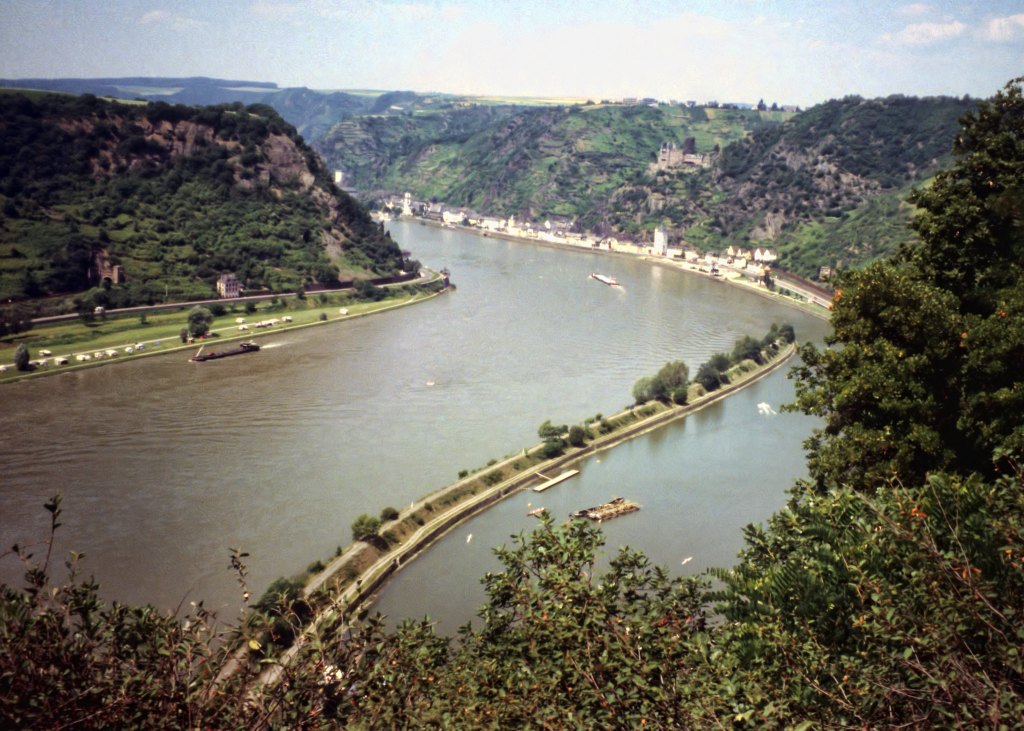
We got to the Rhine River and head south, turning back eastward towards Frankfurt. There was a stop at the Loreley, a narrow portion of the Rhine with a sharp bend where plenty of boats had sunk. A little further down, we spent some time in the small town of Rϋdesheim, another perfect German town with narrow streets and plenty of old, timber-framed buildings. I always got a kick out of these places that were so textbook German. Here we took a cable car up the steep hills to the Niederwal Denkmal, a massive monument overlooking the Rhine that commemorates the unification of Germany in 1871. It was one of my first face-to-face experiences with the history of the country. There would be plenty more history to come. I didn’t know many words in German, but I knew that.
##
The weekend brought an opportunity for one of those great German experiences – the town festival. Every town had its own festival, often for a reason, but often that reason was just to hold a festival.
Being in 4-H meant a lot of time at the county fair. It was no surprise, then, that my first thought upon arriving with my host family (minus Carsten, who was at a party) at the festival in the next village over, Ahausen, was that it looked a little like the county fair back home. There were some carnival rides and games. A large tent was set up for food and programs. The major difference was, of course, beer. And while back in Ohio, many fairgoers would have liked to have had a beer at the fair, here it was the principal reason for the festival. Or so it seemed.
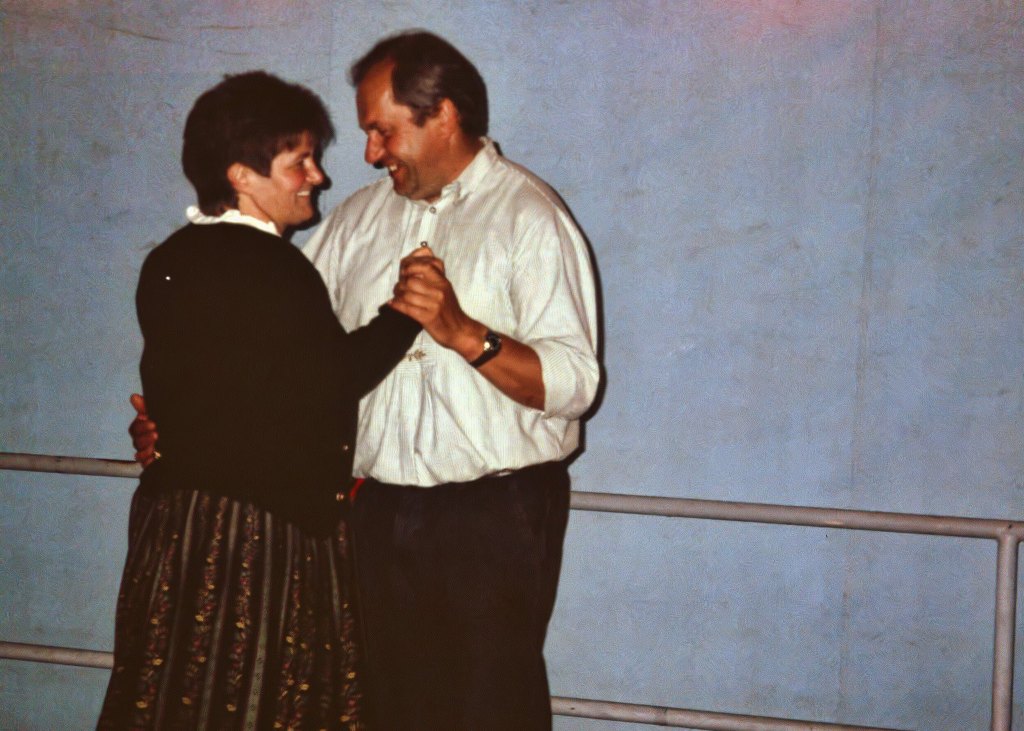
The festival included a demonstration by a women’s organization, which included my host mom, doing some traditional dances, followed by a band that cranked up some good German tunes and allowed the dance floor to really get moving. Wolfgang and Gerda were out there in the midst of the fray, swinging in a tight circle as they skipped in a larger circle around the entire dance floor at a high rate of speed, surrounded by a dozen other couples all doing the same thing at the same insane pace. I instinctively looked around for medics who should have been waiting in the wings to treat the impending injured. Surprisingly, there were none around.
Meanwhile, those who weren’t dancing were drinking beer. Except for the lone American in the tent.
Rainer appeared at our table with two beers, having graciously gotten one for me. The look on his face when I told him I didn’t drink beer was a mix of confusion and incredulity. Don’t drink beer? He asked me to confirm what he thought he had heard. I don’t drink beer, I repeated. Never had. Didn’t plan to. He processed this for a moment, standing there with a pint of beer in each hand. Not even German beer? Not even German beer. He had to sit down. I think it was too much for him to handle. He tried his best to convince me that this was different than American beer. This was German beer. I told him I was sure it was better than American beer. He felt that, surely if I just tried it, I would see how good it was. I passed.
My host parents took a break from the dance floor and joined us at the table. They were told the terrible news. I didn’t drink beer. Up to this point, I had somehow managed to avoid having to be offered beer at the house, usually by having a bottle of Coke or mineral water and juice already in hand. While Rainer worked on his beer, they tried to sort out what this meant, and in the end, came to the happy realization that, while I didn’t want to drink beer, I could drive. I was promptly handed the keys to the family car and made the designated driver for the night.
Rainer realized that he now had two beers for himself, which seemed to make him forget the confusion caused by the American who didn’t drink beer. Even German beer.
Having graduated from college a month earlier, my main reference to drinking alcohol was related to fraternities. And while I could count on one hand the number of fraternity parties I had been to (with a few fingers left over to make rude gestures), I had seen the amount of drinking there. All I can say is, next to a hearty German family, those college students were amateurs. Meanwhile, I was provided with as much Coke as I could drink.
Around midnight, just as the drinking really seemed to be revving up, I was asked to drive Gerda and cousin Stefanie to pick up Carsten from his party. The party itself was in a clearing in the woods somewhere nearby. Four wrong turns later, we found the light from the bonfire and soon after found Carsten, who seemed to have had his fair share of beer, too. We helped him to the car as apparently, the Earth was shifting severely under his feet. We headed back to Ahausen and rejoined the party in the beer tent, where Carsten happily joined the rest of the family in ordering more beers.
Soon, though, it was time to head home. We crammed into the car with me behind the wheel. Carsten somehow ended up in the passenger seat under the drunken impression that I didn’t know how to get back to the house and that he would be the navigator. As it turned out, I didn’t actually know how to get back to the house, even though it was only ten minutes away. But ten minutes in which direction? Regardless, we took off into the night, leaving the carnival lights behind and heading out into the dark. Carsten provided directions, in German, and I got the basic “left” and “right.” Then he would spit out a string of words while pointing off into the dark beyond the windshield. What? Did he tell me to turn here? Go left at the sign? Go around the bend, across the bridge, past Old Man Johnson’s place, where we would see the goat standing on the hay bale, only to realize we had gone too far and then turn around? I took a chance. I hit the turn signal as we came up to an intersection. Someone from the backseat managed to tell me I needed to go straight. Ah. So that’s what he said.
The directions from my navigator didn’t improve from that point on, and I still don’t know how we got home.
##
Journal entry from July 3 (20 days in Germany) – “I think I can say schloβ now without everyone laughing.”
Shame I only had one day left with the Gaths so they could enjoy my newfound linguistic skills.
 One Guy's Writings