Or how do you drink wine?
By Guy Thompson
How long does it take to become part of a family? It’s a question that most of us don’t normally contemplate, as we grow up in a family and are a part of it from day one. Exchange students can often look back and see when they first felt like part of their host family, and even that will depend on a variety of factors. For me, it was clearly less than the three weeks I spent with the Gaths.
The calendar had turned over to July, it was July 4 in fact, and I would head out tomorrow. I worked to pack all of my stuff back into the suitcases. Did this crap multiply? It was tough, but I eventually got my suitcases to close, then found something else hiding in the corner of the room that needed packed, and had to work out how it was all going to fit again. Bugger.
There were last-minute photos and a cookout with the family. As we relived the past three weeks, it became apparent that I was really going to miss the Gaths. I was going to miss playing Blackjack with Rainer, where we placed our bets in ice cream, and paid up later when we went into town. I ended up buying him a lot of ice cream. I would miss the evenings hanging out between the house and barn just goofing off in an impromptu game of badminton. There was no net or court, just two or three of us bashing the shuttlecock around like a game of keep-away. I would miss their eagerness to take me to all of the interesting sites and castles within driving distance of the farm. I would miss being part of the Gath family.
I would not miss the flies, though. It was a nighttime ritual to spend thirty minutes seeking out and killing every fly I could in my bedroom before turning off the light and getting into bed. Then turn the light back on to find the one fly I had missed. Turn off the light. And repeat until about midnight. Then I would wake at dawn to a fly dive bombing my face.
But I was going to miss everything else. I had left my family and fiancé back in Ohio, and that had been rough. This was similar as I was again leaving the known to travel into the unknown. I knew only where they lived, a small town about equal distance away from Frankfurt in the other direction, named Groβostheim, and the family name – Höflich. They, however, did know something about me. Someone from the family had called the Gaths and had asked about me so that they would recognize me at the train station. Holgar told them I would be wearing sunglasses (did I really wear them that much?) and would have roughly a metric ton of luggage. Bring a truck if they have one.
##
The Höflichs met me at the train station minutes after I arrived, missing the amazing demonstration of my skills at disembarking with my inanimate entourage, while being timed by the station’s clock, ticking away the seconds until the train would pull away, even if my suitcases were still on board. I made sure to wear my sunglasses, just in case the luggage didn’t give me away. They hustled up the stairs and onto the platform, recognizing me instantly, mostly because I had been the only one to get off at the Aschaffenburg station.
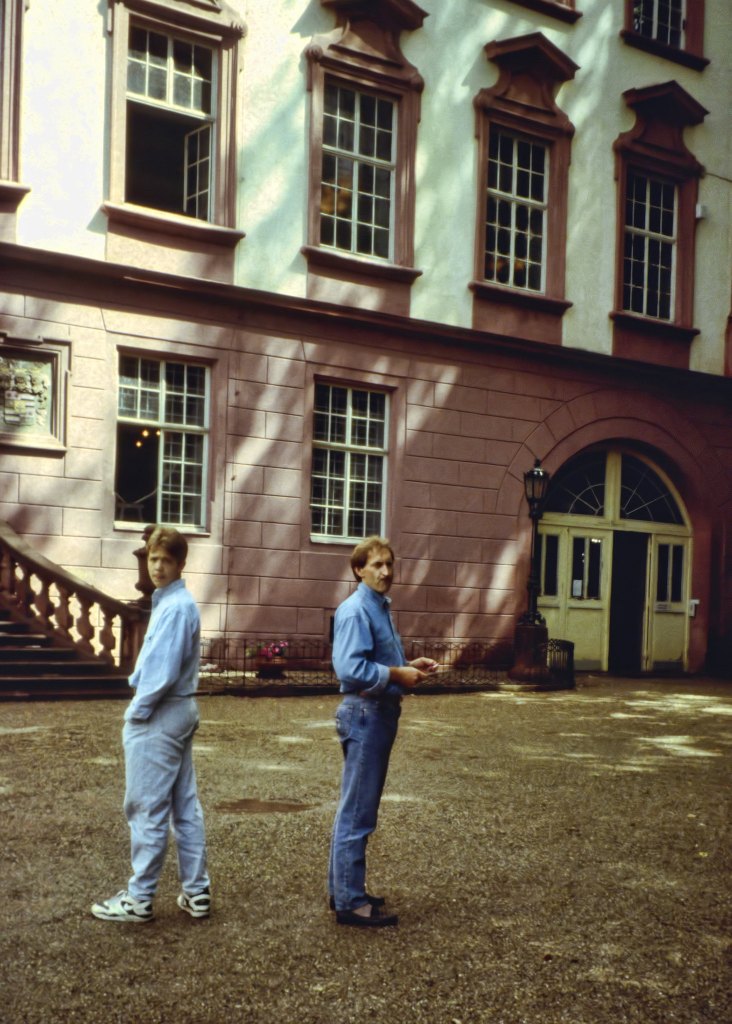
The Höflichs were a family of four – father Peter, mom Gisela, brother Frank (14), and sister Eva (10), who owned a vineyard, or Weingut. After managing to put my luggage in their car, a BMW sedan with just enough trunk space for my luggage, we ate lunch inside the nearby castle, and I somehow managed to say Schloss properly, thus giving them false hope about my German language skills. Still, the Höflichs quickly reached the limits of my German language skills. Gisela and Frank spoke English very well, while Peter and Eva did not. Eva hadn’t gotten to the grade level where they started but would in the next year or two. The Gaths, knowing all too well how much German I spoke, had sent me along with their copy of the German-English dictionary. So that quickly came out as the Höflichs asked the usual questions. What did I do back in America? Did I like my last family? Why did I want to live in Germany? Why hadn’t I learned more German before arriving?
After lunch, it was a quick 20-minute dash to Groβostheim, through the twisty streets, catching a glimpse of the town square as Gisela tried to explain that it was very famous throughout Germany for being in television or a movie, back out of town, up a small hill surrounded by fields, and into the courtyard of their vineyard. Even before we messed with my suitcases, I was given a tour of the business. The barn that housed the fermentation tanks was fairly new as the business had started producing wines only four years ago, already winning awards. An office separated the production area from the tasting room and Peter had me wait for a moment in the small entrance area by the office while he got something out of a side room. He reappeared a moment later with two glasses. The small one, similar to a shot glass but slender, held a clear liquid, while the wine glass held the slightly yellow liquid I knew to be white wine. Peter held out the small glass. “Probieren,” he said and indicated I should take the glass. I did. He mimed smelling it. I did.
We’ve established I don’t drink beer. I don’t drink much, period. I’m not a teetotaler; I didn’t grow up in a house that drank and never really tried it myself. Up until this point in my life, my total amount of alcohol consumed would have barely filled an average-sized wine goblet. I couldn’t have told you what made a good wine versus a bad wine. So it is due to this lack of alcoholic knowledge that I honestly thought that the clear liquid in the small glass that my new host dad wanted me to taste was turpentine.
Obviously, my host family wasn’t trying to poison me, but I had no other reference point for what I was smelling.
Peter just smiled and repeated “Probieren.” He was clearly anxious to see what I thought of it.
I took a sip. It burned all the way down my throat. I tried not to cry. I smiled back and nodded. Yes. That was some kind of liquid, all right.
Undaunted by my reaction to whatever the hell that was, Peter took the small glass from my hand and replaced it with the wine glass. “Probieren.” I sniffed and recognized the familiar scent of wine. I sipped the wine. Either the previous drink had burned off all the nerve endings, or this was much smoother than the first one. I smiled and nodded. Yes, very good.
I would soon learn that the first drink was Mirabelle schnapps. They made a variety of different schnapps, but from that point on, I did my best to avoid them. I’m sure they were great for those who liked schnapps, but I clearly wasn’t going to be among them.
##
To paraphrase a line from a Monty Python sketch, “I may not know much about wine, but I know what I like.”
Seven days into my stay with the Höflichs, I felt I was getting the hang of drinking wine. I had managed to avoid any more schnapps and was at a place where I could comfortably consume a glass of wine with dinner. This was a far cry from the few sips I took my first night with the Höflichs when we joined a couple of their friends at a Gasthaus in Weilburg which, coincidentally, served the Höflichs’ wines.
My limit was still one glass with a meal. It didn’t seem necessary to have more than that, really.
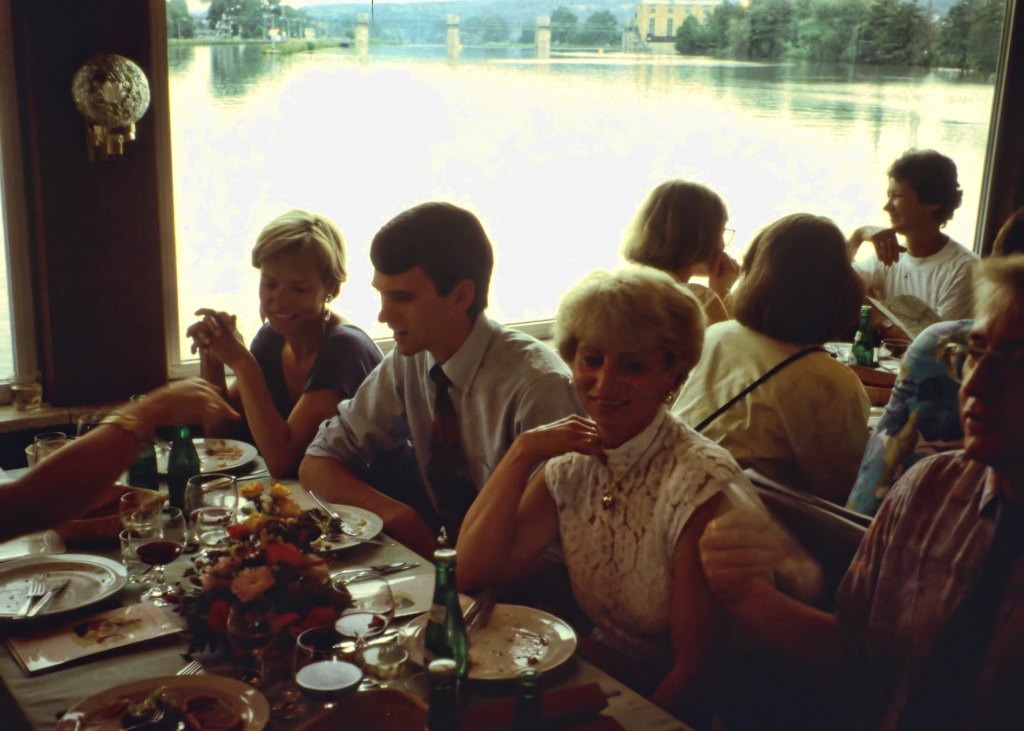
I assumed I was about to set a new personal record of alcohol consumed in a single day as I boarded a ship called The Bacchus (yes, really) for an evening-long wine-tasting cruise that had been organized by a group of winemakers in the region and the Höflichs went to check out what other producers were doing. We met a group of their friends there and claimed a table. It didn’t take long for the wine to start. First up, a 1989 Traminer Spätlese.
These people tasted the wine like I taste a Reese’s Peanut Butter Cup – very intensely. The servers came around and poured a full glass for each person at the table. Peter and those who were there to really test the wines would pick the glass up and look through it. Study it as if they were a doctor examining the x-ray of a very ill person, looking for that one spot that would tell them all they needed to know. They would swirl it around, a little trick that I tried to imitate with fairly disastrous results as wine sloshed out and onto the table. Then they would smell it, eyes closed, and then seem to think about all of this before they would open their eyes and allow themselves a sip. The eyes would close again as they swished the wine around their mouths before allowing the wine to be swallowed.
My method was slightly simpler. I had already seen enough in picking it up to determine if it was red or white. That part was easy. I would sniff at the top of the glass to confirm that, yes, it did smell like wine. I would then sip at it. Yep. Definitely wine. I would sip a little more as I ate. Gulping down wine wasn’t going to happen for me. Sip. Eat. Sip. Repeat.
Then the servers came back with another wine. There was a massive wine glass in the middle of the table that I had mistaken for a table ornament. It was there for those at the table to pour the remaining wine from their glass into. The servers would fill the glasses back up with the next wine on the program, a 1991 Portugieser Qualitatswein. And that was only the first of two wines for the second course. I looked ahead at the program and saw that the main course alone had three types of wine served.
Oh boy.
If I was forced to pick a day that I would have to live over and over, a la “Groundhog Day,” this one would really be in the running. There was time in between courses for us to leave our table and go up to the top deck, which was open to the darkening sky. It was a pleasant July evening, and the boat slipped past a handful of German towns, each a candidate for a perfect postcard shot, and above us, the sky continually changed in a most entertaining way as it headed into night, and the towns became clusters of lights spaced unevenly along our route. The Main River (pronounced Mine, in case you were wondering) flowed steadily along between steep hills. Not quite a canyon, but enough so that all we could see was the narrow part of flat land, the steep hillsides covered with vineyards, and a canvas of sky above. Beyond that, the world might as well not have existed.
The group of us would sit and chat, the Höflichs’ friends asking me the usual questions that I was slowly learning how to understand in German and even manage a one- or two-word answer in German. Sure, the one-word answers were yes or no, but it was a start. There would be an announcement, and we’d head back down to the table for the next course and the next wine to taste. There would be a lot of squinting at the wine as if it was being interrogated and forced to reveal its secrets. Sniffing. Twirling. Tasting. Peter and the other wine producers would often write down some notes on the program, noting how the wine tasted or perhaps just a random thought that they didn’t want to forget. Hard to tell.
I would sip. Think about the wine and make my own mental notes.
Hmmm. Yes. This one seems very winey, almost like grapes that have been squished (a technical term) and left to stew in their own juices, as it were. Perhaps a bit acidic, but in a non-threatening way, much like a mugger who is only using a puppet to attack you. And, yes, I’m tasting this now, a bit earthy. Not dirt. Not earth, but earthy. No idea what that means, but I heard it once. So it’s a thing.
And then back up top to enjoy the evening.
Of course, I was the odd man out on this evening. The others were married or a “couple” in the case of one pair of their friends. (They would later get engaged while I was with the Höflichs.) I was already engaged and really wished my fiancé was there, too. Not for the wine, she wouldn’t have bothered with much more than a sniff at any of the wines offered. Rather for the scenery, which was beyond compare. And the camaraderie that the wine and the perfect evening brought about. If she had been there, then it would be no contest as to which day I would pick to relive if I ever had to learn some important lesson via a Groundhog Day-type experience.
The evening ended 14 wines later, and throughout the cruise, I had learned more than I thought possible about wines. I now knew that I preferred white over red and that, among the ones tasted that evening, the Riesling Spätlese was my favorite. I think that one was just slightly drier than some of the other ones. And I have no idea how a liquid drink can be dry, but there it is.
##
Odors are one of those things that trigger memories. There is a particular scent of fresh, clean air that takes me back to a specific breezeway on the south side of Adelaide, South Australia. Newsprint, after more than 15 years in the paper business, is definitely one of those things that put me back there. The smell of a dairy farm will take me back to the Gath’s rolling pastures in Heβen in a heartbeat.
And the smell of fermenting alcohol of any kind will transport me back to the production area at the Höflichs faster than a Star Trek transporter. Years ago, we took a tour of a distillery near Lexington, Kentucky, and while it was interesting, it was one of the last stops on tour, the large barn where the bourbon whiskey was fermenting that made me stop in my tracks and just soak in the aroma. It was a different type of alcohol, sure, but the smell was the same one that permeated the whole business at the Höflichs.
No offense to dairy farms, but the smell of a vineyard is way more pleasant.
##
July was half over, which meant something, but I couldn’t remember what, exactly.
Oh right. I would officially be getting older. I have had two birthdays while overseas, and this one would be celebrated with the Höflichs, though how I didn’t know.
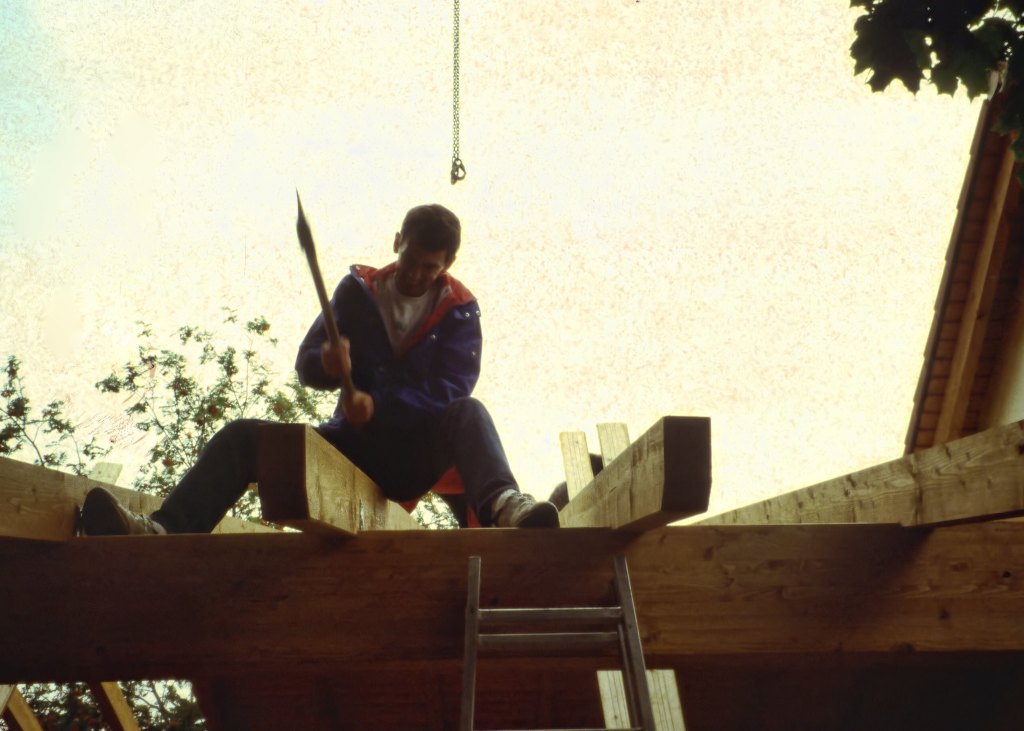
The day before, we worked on finishing up their new carport, which had been built over the past few days. I had helped as much as anyone in the family could which consisted of scrambling up onto the peak to take a few whacks at a wooden peg in the timber-framed structure, more for a photo opportunity than any real assistance with the job at hand. Following that, there was a toast (with their wine) to the building, and then we turned it back over to the professionals who had brought a crane and would do most of the work.
Done.
That evening, we made a run into Aschaffenburg to what was the German equivalent of Sam’s Club to stock up on supplies for the upcoming big festival at their place. I was only mildly disappointed to realize that this was an annual event and it wasn’t, in fact, just for my birthday.
Later that night, Peter and Gisela sat around with me talking, asking those questions that seemed to come up throughout the time with a host family. What was I planning to do when I got home? What were some of the wedding plans? And so on. I kept looking at my watch. It was getting really late, and I knew we would be working to prepare for the festival tomorrow.
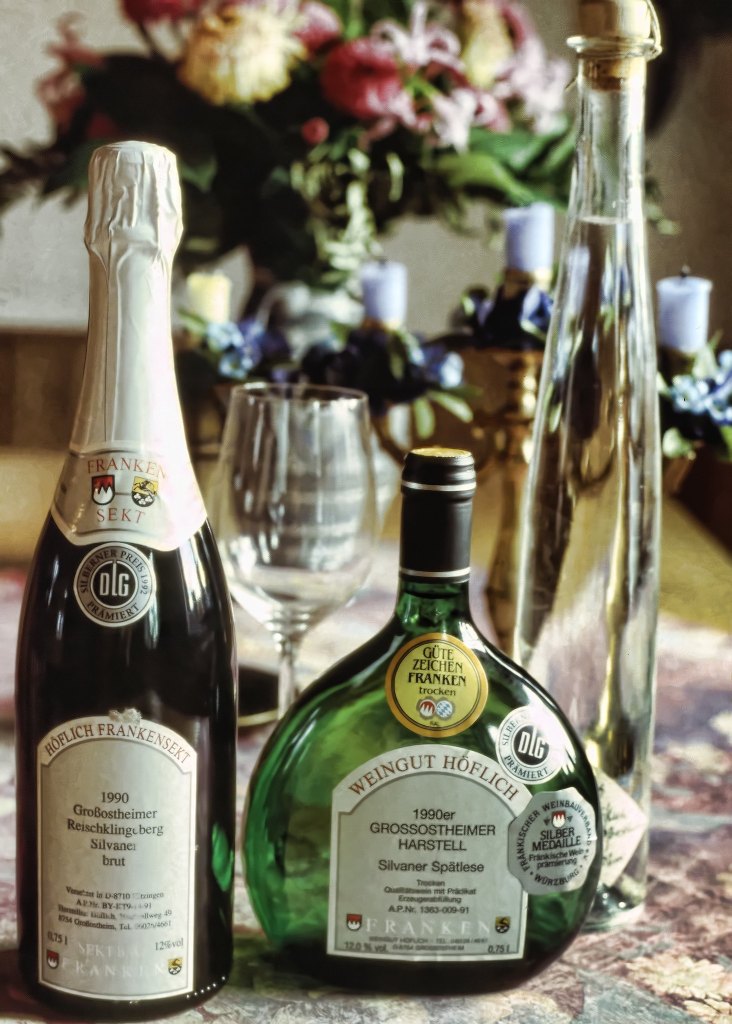
Turns out it was just a ruse to stay up late because as soon as the clock struck midnight – POP – Peter popped the cork on a bottle of their champagne (technically sparkling wine, but still…) It was officially my birthday. They had kept me up until then so we could all have a toast for the day.
We would stay up until two in the morning talking even more. All-in-all, a great way to start the day.
##
Did the construction crew miss the memo? It was my birthday! So why were they out at this hour already? My room was on the side of the house closest to the carport/construction site, and the rumble of heavy equipment meant that there would be no sleeping in for this birthday.
After breakfast, the family helped with roofing the carport. I would have been fine with the construction crew doing it since they hadn’t let me sleep in, but that wasn’t how it was done, apparently. I think the work done by the Höflichs on the carport was more symbolic than actual, as we placed a handful of the very heavy clay roofing tiles, and then turned it back over to the crew.
The day went quickly as we worked around the vineyard, putting labels on bottles, moving things around to prepare for the hoards of people who would arrive that weekend, and so on.
That evening, Peter decided that, since it was my birthday, we really needed to do something special to cap off the day. Perhaps a nice meal. Perfect! Peter and I hopped into his car and zipped off to Aschaffenburg. Apparently, Groβostheim didn’t have a fancy enough place for such an occasion as this, although that Gasthaus we ate at my first night here was nice. Nope, this was bound to be a meal I was meant to remember for the rest of my life.
We pulled into the McDonald’s at the train station.
Let this be a lesson as to what one jokes about while in another country. I had been joking with Gisela the other day about going to a McDonald’s since, you know, it was so American and obviously, I missed that good American food wrapped in waxy paper. And half-warm fries. And a Coke. (Though Coke was as prevalent as beer, including in McDonald’s, oddly enough.)
It was, though, a very nice way to cap off this day – sitting in a train station at McDonald’s with Peter and doing the best we could to communicate. Yeah. Really kicking myself for not learning more German at this point.
##
The party is over. And boy, what a party it was. If you like wine, that is; and apparently, a lot of people do.
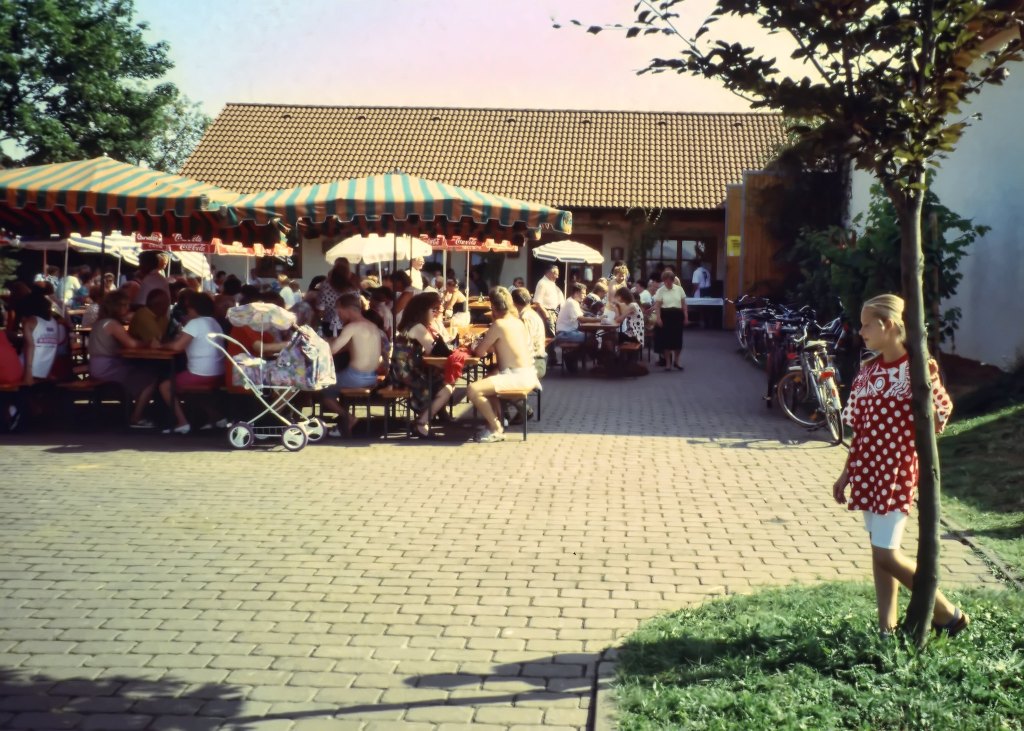
The annual wine fest went Saturday through Monday (though technically it didn’t end until 2 a.m. Tuesday), and we served an absolute boatload of wine. It kicked off Friday with a trip to Aschaffenburg for a television appearance for Peter and Gisela. The focus was on Peter’s wine, particularly the Eiswein, where the grapes are picked after they have frozen on the vines. It produces a very golden, sweet wine, which costs about three times the amount of regular wine. This, as they say, is the good stuff.
I did my best to make sure I stayed off of any German television screens.
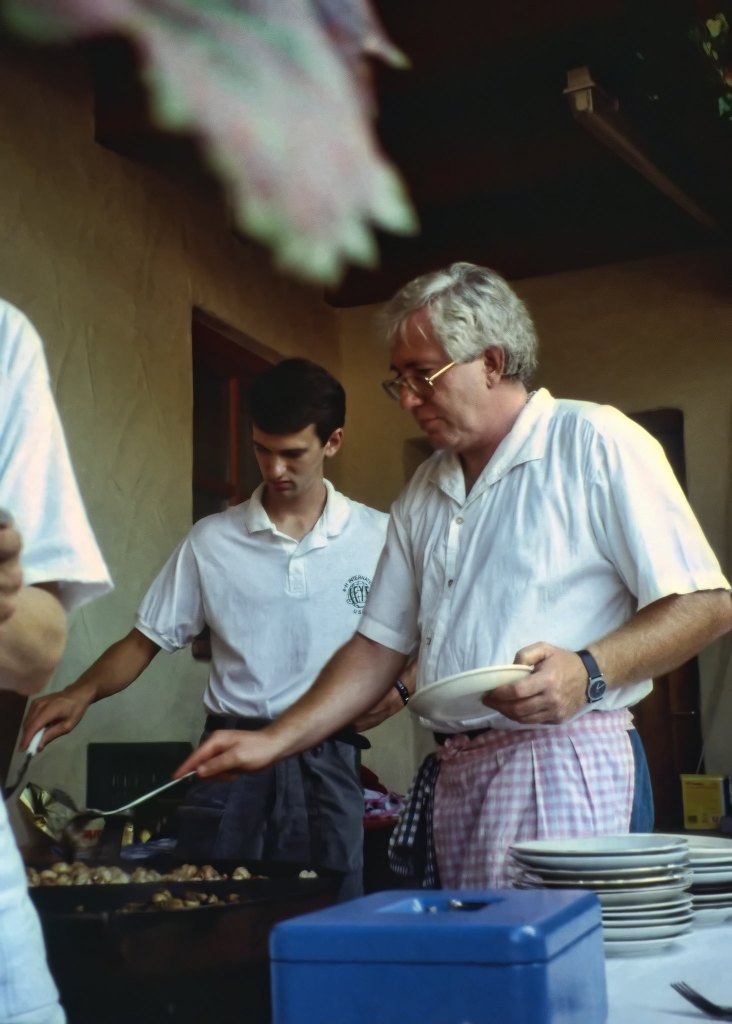
The brick courtyard in between the Höflichs’ house and the wine barn was filled with tables and a large wine bar just inside the doors that led into the production area. I was given the task of cooking and was set up under the overhang in front of the office and tasting room building. Apparently, something got very lost in translation for them to think that having me cook was a good thing. And to make matters worse, I was cooking two of my least favorite things – onions and mushrooms. It did smell good, though. Maybe that was because of all the wine we poured into the massive skillet. Whatever it was, people couldn’t get enough of it, and I got to stir onions and mushrooms all day long.
In the middle of all of the chaos that is normal for such a festival, I could hear music. It was, I was shocked to realize, “It’s a Small World.” No words, just the music, as if hummed by a thousand previous IFYEs. I looked around and saw nothing out of the ordinary. Another patron came up and asked for a plate of the stuff I was cooking. But she asked in English. I said sure thing. Here you go. And in English.
Then we realized what had just happened. Turns out, there were two of them from America here, at the Höflichs’ wine fest. How they got here or why they came to that place, I don’t know. Everything else stopped, though, as we talked for a few minutes. They wanted to know how I had gotten there, on a German vineyard, stirring a concoction of onions and mushrooms and white wine. I was, I informed them, an IFYE. I started to explain what that meant, but they stopped me.
Her dad had been an IFYE when he was younger, and their family in Minnesota had hosted plenty of IFYEs over the years. Yep, she knew what an IFYE was.
Unfortunately, duty called, and it was back to the onions and mushrooms. We said our goodbyes and wished each other the best.
And then the music stopped. But had it really been there?
##
In a place as old as Europe, there is more history than most people know what to do with. Most of that history is old, as witnessed by the castles and towns, such as seeing the oldest Gasthaus in Germany, Zum Riesen, in Miltenberg, just down the river from Groβostheim. It was established as early as 1411. The Würzburg Residence, a palatial building originally built in 1744, years before our own revolutionary war. Fun stuff like that.
For the first time, and certainly not the last, more recent history would make its presence known.
Before I moved on, there was a final tour arranged by the Höflichs for me. A representative from the Landwirtschaft (agriculture office) took me on a day tour of some of the other farms in the area. The gentleman was missing an arm, lost, he told me, in an American bombing raid on his town when he was a child. I sat there in the passenger seat of the car, unsure what to say about that. He, however, seemed totally fine with this event, done half a century earlier.
But it did remind me of where I was in a whole new way. There was more to this place than farms, castles, and wine festivals. History was here, too, and was not confined to a book, but could be recounted by a live person.
##
My time on the vineyard was rapidly coming to an end. Despite my efforts to maintain a low profile, the Höflichs arranged for the local paper to send a reporter out to interview me and take a few photos of me looking very serious as I pretended I knew what I was doing on a vineyard. I answered the typical questions: Was I enjoying it here? Why did I decide to come to Germany? Why hadn’t I learned more German before arriving?
We took a next-to-last trip to Aschaffenburg the night before I was to leave for my next family. On the way back, I was allowed to drive! On the Autobahn! In a BMW… oh well. It was still pretty good. Going 140 km/h was something else until that Porsche blew our doors off.
The final evening was one of those nights that pop up in my memory from time to time in a very pleasant way. We had a cookout on the back patio at the house. Friends came over. We drank wine. We talked a lot. We didn’t go to bed until it was late.
The following day it was time to leave. And it wasn’t any easier the second time around, either. I had become as much of a part of the Höflich family as I had with the Gaths. With my suitcase now weighed down with a bottle or two of wine, I got on the train at Aschaffenburg and waved as the train pulled away.
Onward, then. I didn’t know what waited for me in Baden-Württemberg. The family name was Brudys, and the town they lived in was, according to the maps, just a few kilometers away from the French border.
But I did know that the city of Stuttgart was in the same state. And that, oddly enough, was where Porsches were built. So with that thought firmly in mind, I headed west.

 One Guy's Writings
Guy, I am so enjoying your stories ! I was an IFYE to the United Kingdom in 1968. And no, I had no language barrier but I can relate to getting off the train with heavy luggage. Why had nobody invented the wheels on the bottom of suitcases then ? Staying up late with the families and visiting. Drinking wine which I had never done before ! Saying goodbye to families that I learned to love in such a short time. I went back two years later to the Netherlands on a mission trip for one year. It was then I experienced a language barrier. I stayed in contact with my host families for many years but they are not living anymore. I represented Kansas in 1968. We live in Oklahoma now. There is no IFYE program here. I tried to get people involved but with no success.
LikeLike
Thank you! I’m glad you’re enjoying the stories. It’s been a lot of fun going back through the old photos and notes and remembering so much. Still a highlight of my life! Thanks again!
LikeLike