Or Why I Won’t Get a Plum-Colored Porsche. Ever.
by Guy Thompson
It sounded like cannon fire. There was a deep BOOM. I’m pretty sure windows rattled.
True, I didn’t have a lot of experience around cannons, but it definitely sounded like something made a very loud BOOM.
It was the second evening at family #3, the Brudy family, and we had been out all day pulling weeds along rows of Johannesberry bushes. It was the end of July and, just like home in Ohio, it was getting very hot and humid. By the second row, I was feeling ill. Call it a combination of heat, dirt, berries, weeds, and whatever insects were buzzing around, but I hadn’t felt this bad in a while, and that included passing out on my first day in Frankfurt.
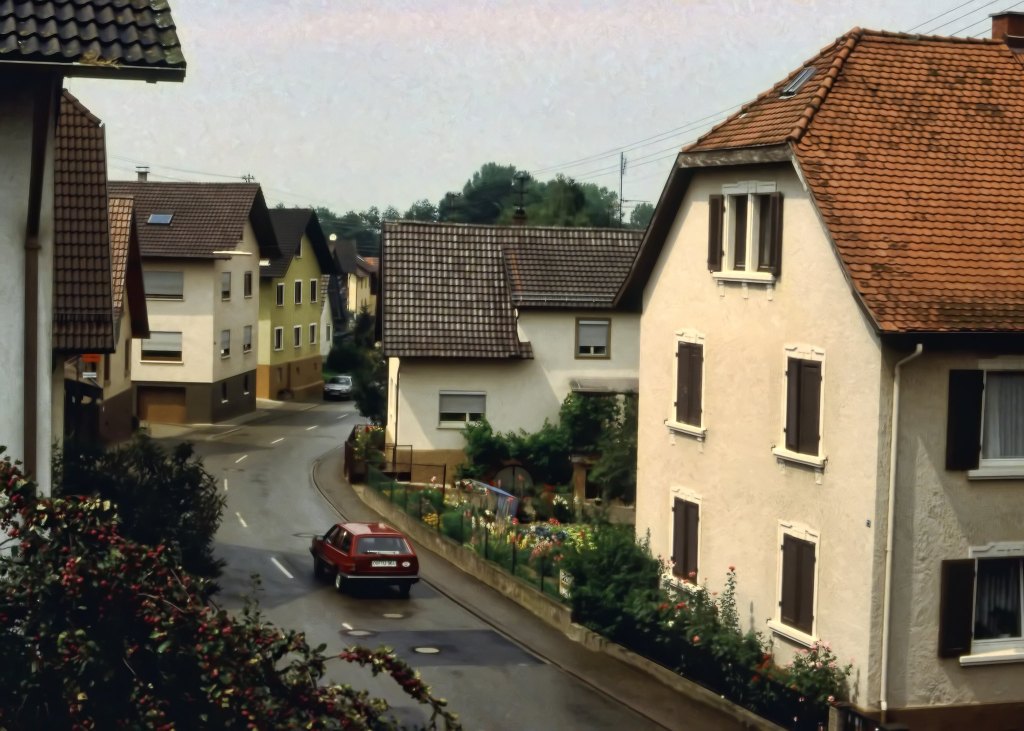
I had been working with my host mom Elisa, not too far from the house and barn, which sat in the middle of Nesselried, in the far west side of Baden-Wurttemberg, not more than half an hour from the French border. Their farm wasn’t in just one spot, as I would find out over the next three weeks. There was the barn with a few hogs, along with a small grove of bushes and trees behind the house there in the middle of town, with a handful of fields scattered about the area to create the whole operation. I found out that in some areas, this was more common than elsewhere.
After the weed pulling was finished, I had a little time before dinner to get a lay of the land. Turns out, there wasn’t much land to get the lay of. Nesselried is a small town. It was one of the towns that were the most difficult to find on the map, and I’m talking about the detailed map I bought specifically to find it on a map. There is a main road that shoots through the town, with only a handful of other streets running off it and scurrying over the nearby hills to other, equally small towns.
It was this main road that I was wandering down when I heard what I thought was a cannon fire. I walked further around the curve to the north of the Brudy home. Up ahead, I saw a fairly large group of people gathered on the sidewalk. It could have been, as far as I knew, the entire population of the town, minus a family or two. Soon, an American snuck into their midst, curious about the cannon and the additional sound of glass and plates breaking that I could hear once I got a little closer.
CRASH. And a cheer from the crowd. SMASH. Another cheer.
What the…?
Friends, family, and some whom I could only assume were total strangers, had gathered in front of this house and were vigorously throwing plates and other porcelain items onto the driveway. There was a large trash dumpster off to the side, but honestly, they weren’t really trying to get any of the stuff into it. If anything, it served as a great target to really smash the plates against.
Wow, I thought, this must be really pissing the family off. What did they do to deserve this?
Nope. The lady of the house was casually walking through the crowd, politely offering drinks and laughing with others.
The husband and a couple of friends were off to the side with what turned out to be a small cannon, small enough that it would easily fit in a small child’s wagon. But also big enough to be able to put a few grams of black powder into the barrel to fire off and create a great cloud of smoke.
A group of men (naturally) who appeared to be a little tipsy (naturally) staggered through the crowd, each doing his part to carry a toilet to the driveway where – SMASH! This got a really big cheer from the crowd for that one. The family laughed. More drinks were served.
I turned around and headed back the way I had come, wondering if I had somehow found myself in one of those alternative reality towns that appear in movies where the whole population has gone mad. This certainly seemed logical based on what I had seen.
I knew I would have to plan my escape carefully. If I had learned anything from those movies, it was that the person who tried to escape often didn’t make it out alive, meeting some gruesome and overly complicated fate. Sneak out at night? Probably my best bet. Which direction? The Black Forest, that fabled place of myths and fairy tales, was just a few kilometers to the east. How long would it take me to traverse it? Would I find other cursed villages such as this one?
I got back to the Brudy house and, in my worst German possible, tried to explain to them what I had seen. Elisa said it was a polterabend.
Ah. Yes. Of course. I nodded politely as the answer did absolutely nothing to tell me if I should take the time to repack my metric ton of luggage or if I should just flee now.
I looked up the term so I would know what I was running from. Along with some very rough translations between myself and the family (more on our language gap in a moment), I found out that a polterabend was a German wedding custom. Friends, family, and some whom I could only assume were total strangers, all show up at the family’s home prior to a couple’s wedding, to gleefully break plates, porcelain, and the occasional toilet, as a way to wish the couple a happy marriage. The theory goes that, by breaking all of the stuff now, a day or so before their wedding, the newlyweds won’t break anything while married, presumably during arguments.
This was truly a lesson in German culture, exactly the sort of thing I was sent here to learn and then share when I returned to Ohio.
I vowed not to breathe a word of this back home to anyone until well after my own wedding the following year.
##
Ah language. What a fickled thing you are.
Just when I thought I could get through this whole trip with my growing, yet still very limited vocabulary of German, I got slapped back into reality. And not that gentle slap where one is trying to wake you up from a pleasant dream. This was a full-on roundhouse right to the side of the face, leaving a very large, red mark kind of slap into reality.
The Brudy family, host dad Otto, mom Elisa, Bernt (22), Klaus (16), Sylvia (13), and Eva (4), may have, in total, known fewer words in English than I did in German. As I wrote in my journal on the second day in Nesselried, there was something wrong here. Not with the family themselves, necessarily, but with the situation. The sudden inability for me to be able to talk to at least one of the family members in English and have them able to translate back and forth was frightening.
The language barrier only exasperated something else that I felt but couldn’t quite place my finger on. It would take almost the entire three weeks in Nesselried before it got sorted out.
##
In August 1992 the Olympics were held in Barcelona, Spain. Like most other people around the world, the Brudy family enjoyed watching the Olympics in the evening. I would sit with them in the living room watching the various events, with an obvious focus on the German athletes and teams.
It was also the first year that professional basketball players could participate in Team USA. So naturally, the U.S. had a team basically full of ringers: Michael Jordan, Scottie Pippen, John Stockton, Karl Malone, Magic Johnson, Larry Bird, Patrick Ewing, Chris Mullin, David Robinson, and Charles Barkley, among a few others who were called up to fill the extra uniforms the team apparently had lying around. I didn’t know much about the NBA, but I knew who these guys were. They were one big steamroller of a team that would crush any other team in its path.
As an exchangee, one tries to be polite and non-confrontational on hot-button topics, and let’s face it, sports is just one massive hot-button topic, no matter where you are in the world. So it was that I ended up sitting with my host family watching the Dream Team play against the German national basketball team. Well, play against may be too strong of a phrase here. At halftime, it was 56-25. The final score was 111 to 68. Ouch. (Though, this wasn’t the biggest win the Dream Team would rack up.)
I kept my head down, didn’t cheer (not that I really wanted to), told them I didn’t really care about basketball anyway and focused on writing a letter home letting them all know how much fun I was having.
For other events, I made a point to root equally for the U.S., Germany, and Australia, depending on the sport and who was playing.
##
Actually aside from a handful of shows, such as the one filmed in Großostheim, news programs, and European sports, a lot of the television content in Germany was American, with a handful of British shows thrown in for good measure. I could watch, if I wanted to, Matlock, the A-Team, game shows, McGyver, Married With Children, and Golden Girls. All the really good ones and all dubbed in German.
I told myself that, the more American shows I watched that had been dubbed into German, the more German I would learn.
Yeah… no.
When trying to speak another language or listen to someone speak their native language, you soon realize that we all speak very fast and are horrible at enunciation. We slur words. Cut off syllables. Smash words together. We make grammar cringe when we speak. Words get tossed around in a sentence like a poorly made chef’s salad.
The same thing happens when something gets dubbed over. The words are spoken just as quickly and just as casually as any other speaker. I was still lost.
Meanwhile, the Brudys seemed frustrated at the language barrier, more frustrated than me, even. A few times, one of the host brothers or sisters would try to tell me something and finally give up after seeing my blank stare that I meant to be interpreted as the international look for “I have no idea what you said. Try again, please.” There was even shouting a few times. This was not going well. I lost track of the times when I thought I had it. I had understood the directions and set about to do that which I had been asked to do, only to find out that I had, in fact, misunderstood every syllable and was doing it entirely wrong. Oh well. I’ll get it right the next time. Right? (I think we know the answer to that.)
Meanwhile, this family worked hard. Not to imply that the Gaths or Höflichs didn’t put in some serious hard work on their farm or Weingut, but something about the way the Brudy family farmed made it feel like they were doing harder work.
All I know is that I felt continually exhausted (and sore and injured) from trying to keep up.
The work shouldn’t have been that bad. Not really. But it was picking up straw bales that did me in.
If I understood correctly, and that was hit and miss, the straw was in a field owned by another farmer, but the Brudys were buying the straw bales from him, and we were going to pick up the bales and bring them back. Easy.
I started off that morning holding my own as I tossed a bale at a time up onto the wagon, where Bernd and Klaus would stack them neatly as the tractor went up and down the field. It became apparent, though, that even though I could, at that time, run a 10K race, actual physical labor was not something I could sustain for very long. I was put up onto the wagon as my arms gave out, trying to haul up the gales and throw them up onto the growing stack. And then – BAM. Something tore in my shoulder. My right arm was almost useless now to handle anything heavy. I was quickly relegated to driving the tractor. I suspect that, by this point, they would have been quite surprised that I could drive a tractor. I couldn’t seem to do much else in regard to farming.
The bales were brought back to the barn, and we unloaded them. Letting gravity do a lot of the work helped, but the damage was done. It would be a battle from that point on to be useful around the farm, and there were still two weeks to go.
It was only recently that I thought I probably should have gone to see a doctor right then and there. I didn’t. Bit of a mistake, there. But they had Advil in Germany, so…
##
One constant in the universe is the fact that it could always be worse.
I was not, to be brutally honest, having a great time with my third family, the Brudys, in Baden-Wurttemberg through the early part of August. Part of it was the fact that it was August and that part of Germany was like so many other parts of the world at that time of year – very hot and very humid. That didn’t mean that we didn’t work outside. We did. A lot. This was, after all, farming.
Part of it, too, was the lingering feeling that something was slightly amiss between myself and the family. Two weeks in and I still didn’t have it sorted out. They were nice, and I thought I was nice, but I clearly was not fitting into the family as well as I had with the Gaths or the Höflichs.
One thing I did enjoy while living there was the trips I took with host dad Otto to farms throughout the region. He had a second job of registering cows and milk production for the government, which meant starting first thing in the morning, heading out of Nesselried and up into the Black Forest to find a couple of farms. It was on some of those trips that I thought of that universal realization that it could be worse. For example, I could be living in a house that was also a barn. A lot of the homes up in the forest had a single, large building that served as both a barn and home, with the living quarters being the second floor while the animals lived just downstairs. Even then, some of the home/barn combos still had hay and equipment stored on the upper level (reached by an inclined driveway), and only a little bit would be the house.
With the Brudy family, I did have my own room, thanks to the fact that my host sister Sylvia was sharing a room with Eva to allow me my own space. And the house and barn, where a handful of pigs lived, were separated by a small courtyard/driveway. We could have been sharing the same structure, something I didn’t think was possible until I visited these farms.
Still, the trips up into the Black Forest remain a memorable experience for me. This wasn’t a guided tour hitting a few tourist traps (I saw a few of those – I’m looking at you Haus of 1,000 Clocks!) but drives on gravel roads that dove headlong into that dark forest, following twisting, winding lanes upward, to emerge in brilliant morning sunlight atop a small mountain next to a lone farm. I ended up in places where we could only see a single farmhouse. This was rare in such a densely populated country. But the hills and forest hid so much.
The families at these houses would invite us in after Otto had done his work and I took some photos. He would introduce me as his gästsohn (guest son), and we would have an absolutely terrible conversation with them as many of them didn’t speak any English, and they were probably wondering why I hadn’t learned more German before coming over. Still, they were always polite and welcoming.
##
For the second time in my life, I was not allowed to go into a casino.
The first had been in Adelaide, South Australia, when I, along with two other American runners and host dad Tony was turned away because one of us didn’t have good enough shoes on. I don’t recall who it was, but I suspect it was me.
Now, the Brudy family and I were denied entry into the Baden-Baden Casino for pretty much the same reason, though it seemed as if they might have been talking about all of us, and not just me. The Brudys were pretty casual folks. Shorts and t-shirts were the common style choice, and one I was comfortable with. No need to dress up much when working in the fields and orchards. Apparently, casinos in Europe (and Australia) felt that if you dressed the way we were dressed, you probably didn’t have enough money for it to be worth their while to let you in. And speaking for myself, they were right. I wasn’t there to gamble away more than 20 Deutsche Marks. Tops.
We had taken a Friday off from working around the farm and traveled about an hour north to Baden-Baden, a town known best for its… well, baths. In fact, Baden means “to bathe” or just bath, so we were visiting a town called Bath-Bath. For the Brudys, seeing the town consisted primarily of walking around and looking at the outside of stuff. Outside of a church. Check. Outside of a museum. Check. Outside of stores. Check. The inside of these places looked pretty much the same in Baden-Baden as the inside of other churches, museums, and stores in all the other towns I had visited, so I don’t feel that I missed much. After a while, even the castles all looked pretty much the same on the inside, so that excitement had worn off earlier.
We drove back on the Black Forest High Road, which gave some incredible views of this mythic and amazing part of the world. It was easy to see why the stories collected by the Brothers Grimm used this area so much. A lot of weird and terrible things could happen back in the shadows.
We stopped in a shaded picnic grotto somewhere along the route and had a wonderful little picnic. This was one of those things one could only do living with a local family and not as a tourist. There weren’t any tour buses parked along the road, letting off a stream of people who only wanted to stand there long enough to get a photo and hop back on the bus, dreaming of getting to their hotel that evening. Being part of a family meant you got to stop at a little grove and have a nice picnic. Enjoy the view. Swat at German mosquitos. Very traditional.
##
I am not one who is prone to threatening people, but in my journal on August 5, 1992, I wrote “If anyone ever offers me plums, I’ll kill them.” (For the record, I have been offered plums plenty of times, but have yet to actually kill anyone. Now the look I give them…)
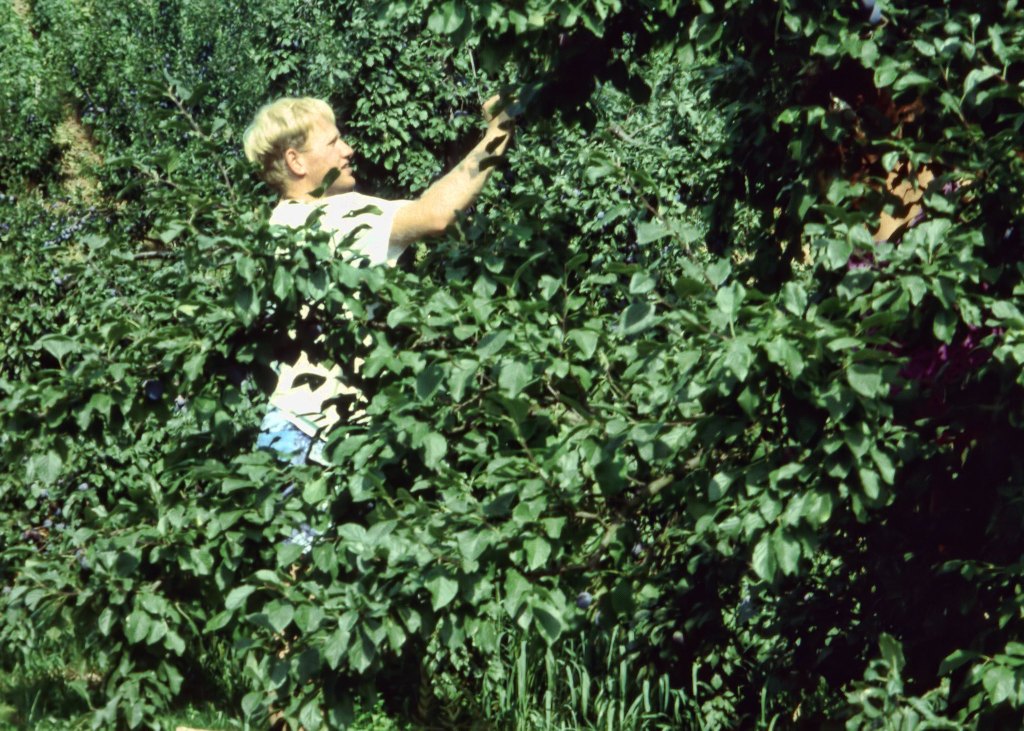
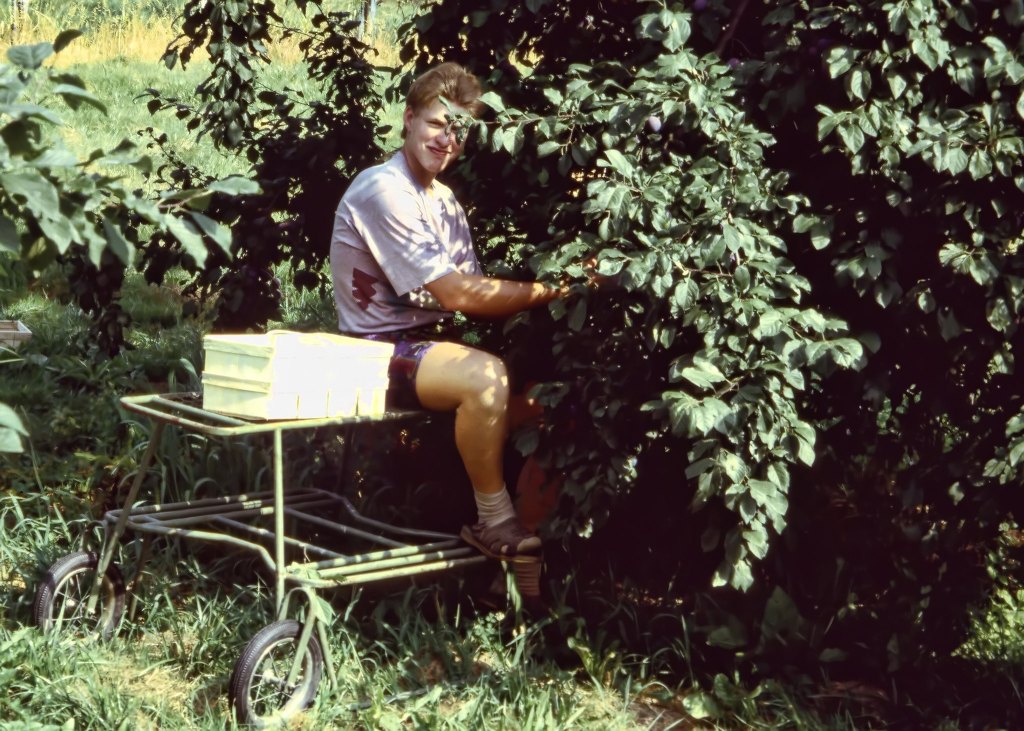
Most of the week after the trip to Bath-Bath (Sorry. Baden-Baden.) was occupied with picking plums. Apparently, like baling straw, plums can only be picked during the hottest, most humid days conceivable. I took a lot of Advil during this time. I won’t say I had an addiction, but without it, I really couldn’t function. The shoulder was not getting better (a simple game of catch was a huge mistake) and there was an orchard full of plums to pick.
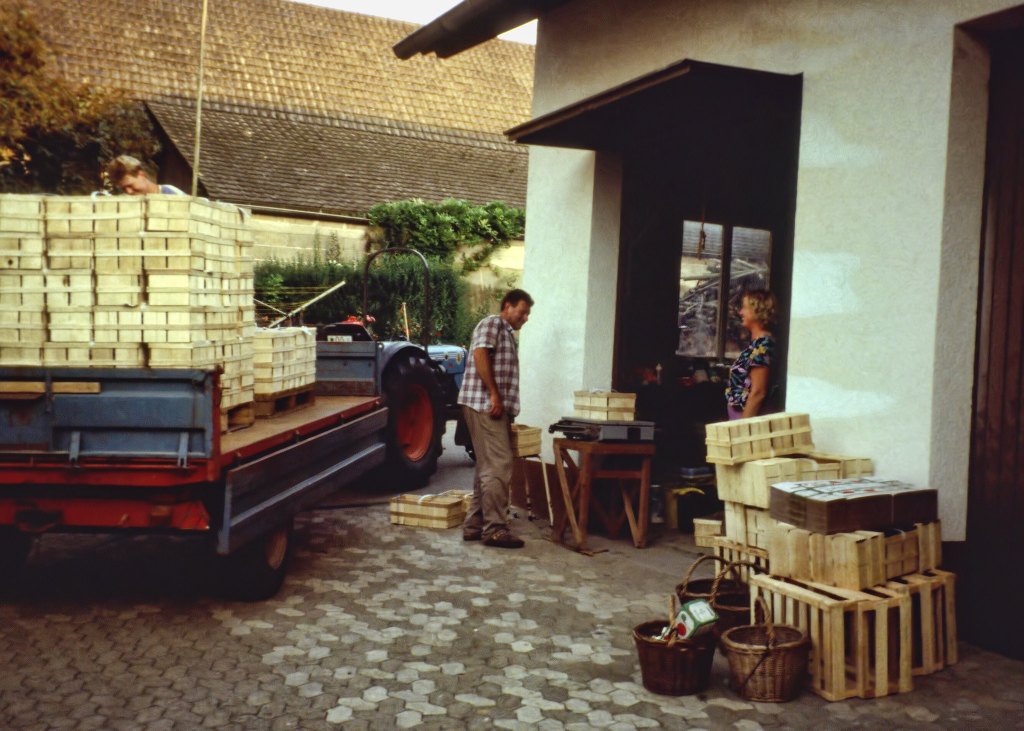
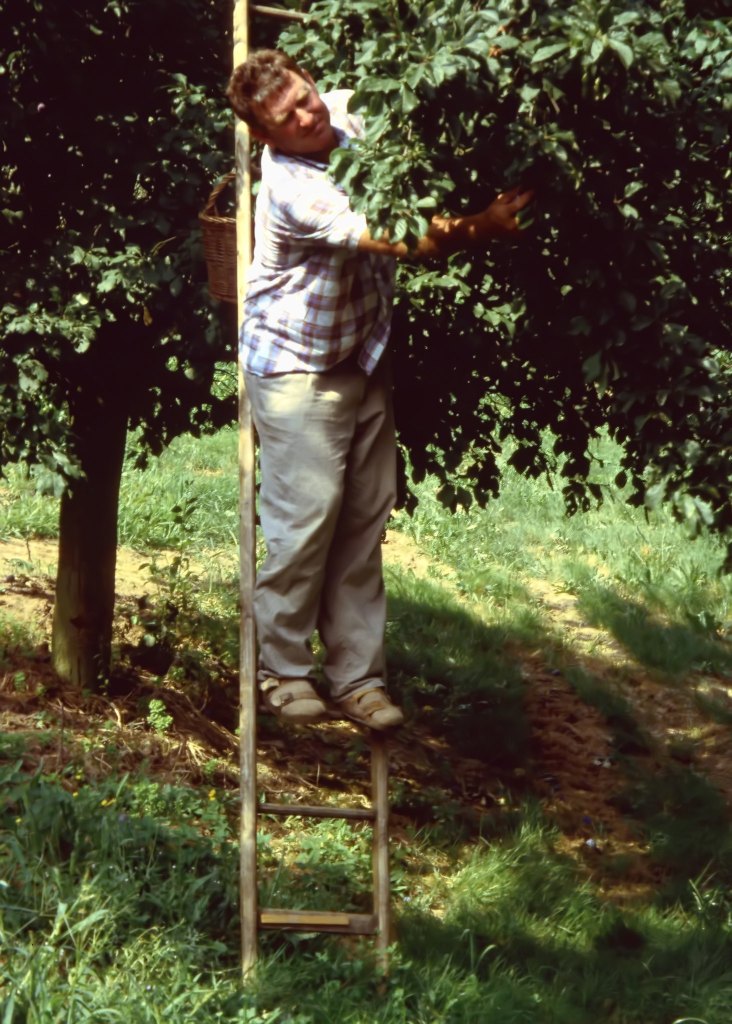
For several days, we would ride on the wagon behind the tractor a kilometer or two out of town to their orchard first thing in the morning and pick plums. And pick. And pick. And break for lunch there in the orchard where everything tasted like plums. Then back to the trees to pick plums. And pick. And pick. It involved going up and down ladders to get the plums on the upper branches. Crouching down to get at the ones on the sagging branches along the edges. Dumping the buckets into crates. Sorting out bad ones. The milky-white film that covered the outside of the plums got on everything. We’d go home around dinner time, eat, clean up, and, speaking for myself, collapse into bed.
When the whole orchard was picked clean, we ended up with a wagon full of plums that Otto and I took down the road with the tractor to a market to sell. It was farming. It was work. Without it, the farm wouldn’t exist. It didn’t actually kill me.
But I still hate plums.
##
There is always a light at the end of the tunnel, even a tunnel that was plum colored and smelled of plums. A couple of days after we delivered the plums, I caught a train to Stuttgart to meet up with one of their cousins who was going to take me around the city, including the fabled Porsche factory and museum.
Feeling like a religious pilgrim setting off, I left early that Monday morning from a nearby train station as Nesselried didn’t have a station of its own. Two hours later, I was in Stuttgart. I could almost smell the Porsches. I met the cousin, a very nice lady named Kalada (I may have that wrong, but that’s what’s in my notes, so…) and the first stop was to the Porsche factory and museum.
We took the city trams (S-Bahn) out to the Porscheplatz stop. Best name ever for a tram stop.
Now, take a moment and Google the Porsche Museum. Go ahead. I’ll wait.
Looks great, doesn’t it? Sleek. Modern. Filled with Porsches from throughout the company’s storied history. Classics. One-of-a-kind cars. Race cars from famous races. A real eye-opener, isn’t it?
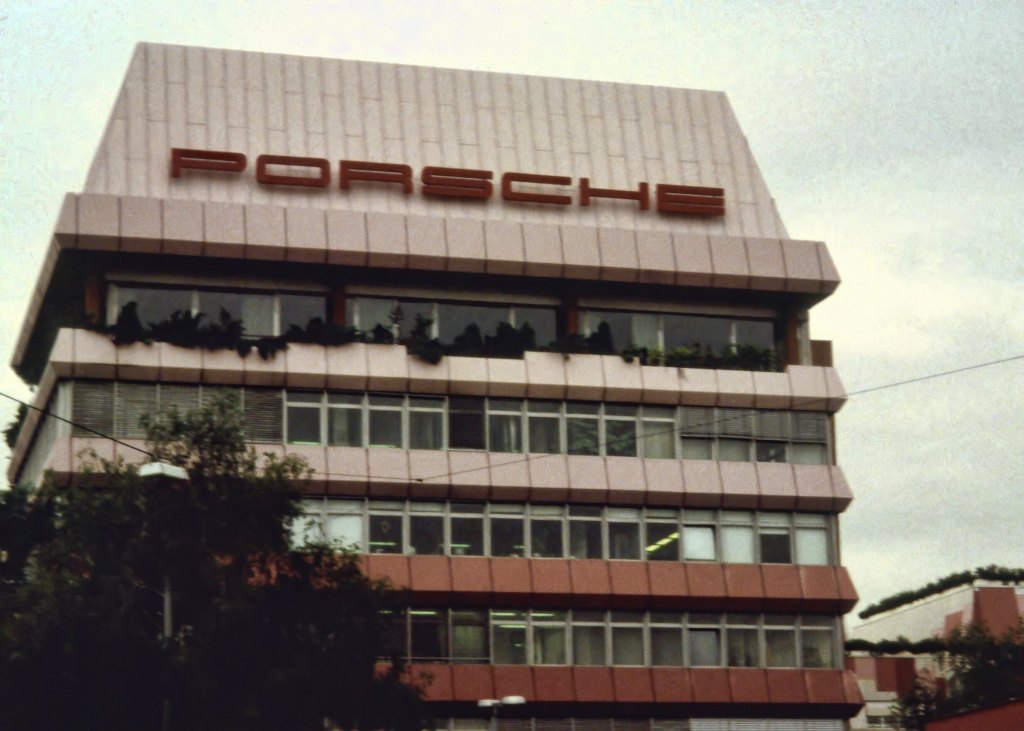
The day I stepped off the tram in 1992, that didn’t exist. We stood and looked at what was basically a factory. True, it was a factory with “Porsche” in its stylish, yet minimalistic lettering across the side of the building. So they didn’t want to spend too much on the outside, I thought. I’m sure the inside of the factory will be amazing, all gleaming and high-techy.
We headed across the street to the public entrance to get in what would surely be a very long line of people waiting for the tour. But there was no line. There was, in fact, no tour. The factory was shut down for retooling.
Okay. We’ll just do the museum tour. No worries. Get to see loads of really cool and historic Porsches all in one place. Maybe gain some insight into how they are designed. All the things that a good museum will impart.
You see where this is going, don’t you?
No, the museum wasn’t closed, but it might as well have been. In 1992, it was only slightly better than seeing a bunch of Porsches lined up in a parking garage. There were a few unique cars. The fabled 959 was there, a highlight that meant I stood looking at it for a minute longer than I did the other Porsches. The Porsche Indy race car. A couple from the LeMans series of old. There were small placards that gave some information on each car. In all, there might have been 20 cars.
I had prepared to spend all day there, but it took less than an hour to go through the museum. And the relatively vast amount of money I had budgeted to get Porsche “stuff” at the museum gift shop went all but untouched. It cost me three times as much for the train ticket to get there than what I spent in the gift shop. Or perhaps it would be better to call it a gift countertop.
Oh well. Onward then, into Stuttgart and its many sights and museums. As it turns out, a lot of museums in the city close on Monday. We walked through the very rainy day and saw what we could before I had to catch the train back. Despite the rain and lack of Porsches, thanks to my guide, I did rather enjoy the day as a whole.
See? Light. End of the tunnel. It happens.
##
Just a couple of days before I was to leave the Brudy family and head for Berlin, we drove a few kilometers to cross into France to the Germanic city of Strasbourg. The city itself had been on both the German side of the border and France side enough times that it was a pretty solid mix of the two. The city itself looked German, and plenty of people spoke German. But it was also very French. People spoke both French and German with equal fervor. Great. Now I could look confused in two languages.
We met up with some friends of the family there in Strasbourg, who had a son a couple of years younger than me, and who spoke fluent English. He was great at describing all of the stuff we saw, particularly about architecture and history. He also had information that finally helped me solve the ongoing problem between myself and the family. For nearly three weeks, although I had a nice time and got to see and do fun things with the family, there was always this odd sense that we weren’t connecting.
Now, with only a couple of days left with them, I found out that the Brudys had been more than a little misled about me. Apparently, they were told that 1) I had a farming background and was studying farming back home; and 2) that I spoke German. Wrong and so wrong. The latter they had figured out about halfway through my first lunch with them three weeks, earlier. The former took a day or two of actual work around the farm.
I suspect that they hadn’t quite figured out how to ask me about the discrepancies between what they were told and what they actually got, and I hadn’t thought that would be an issue. They had expected someone who knew how to farm and could be a real help to them in what was a pretty busy time on the farm. Instead, they got a communication major with a bad shoulder, and equal talents in farming and speaking German.
It was, unfortunately, too late to make any serious amends. It was time for me to pack my suitcases and get dropped off at a train station to catch the train that would eventually get me to Berlin. There, a family by the name of Pluta awaited me. I had to wonder, what had they been told about me?
As usual, I had been told very little about them. Name and address, thank you. And as I assembled my substantial amount of luggage, I wondered what kind of farming I would be doing in Berlin.

 One Guy's Writings