Or how history likes to pounce on you
by Guy Thompson
“Time is a train/Makes the future the past.” — Zoo Station, U2
It may or not have been an accident that the song “Zoo Station,” from the album Achtung Baby, was playing on my Sony Walkman cassette player (Hey, this was 1992 and that was probably the coolest thing I owned) as the train pulled into the real Zoo Station. Or, as it’s known in German, the Zoologischer Bahnhof. Since a U2 song was playing roughly 95 percent of the time on my Walkman, it could have been any song, really, but it seemed most appropriate that it was this song.
Okay. I planned it that way.
It was mid-August and time to head to a new family. The change between family number three, the Brudy family, and my family in Berlin, the Plutas, could not have been more drastic. I was going from a town of a few hundred people and one main road to a city of three million that is half as large in overall size as the entire county I hailed from in Ohio. I was going from the rolling, dark hills of the Black Forest, to one of the most metropolitan cities in the world. I was going from the hard work of farm life to virtually no labor at all (at least on my part.)
It took a single seven-hour train ride to go from one extreme to the other. And for once, I didn’t have to change trains, which was great since my luggage had apparently hadn’t shed a single kilogram. A few stops after leaving the Offenburg Hauptbahnhof, Chris and Melissa joined me, and for the first time since Frankfurt three months earlier, we were all heading to the same place on the same train. And, as usual, we had no idea what was waiting for us at the end of the tracks. In this case, it was literally the end of the tracks as following the construction of the Wall, the Zoo Station was the final stop before East Berlin, and there wasn’t a lot of anything crossing that border until just three years prior to my arrival.
We stepped off the train and exited the station, coming out to a scene of a man being arrested by the police. Definitely hadn’t seen that back in Appenweier. Actually, I don’t recall seeing any police at all. Ah… life in the big city.
Within moments, I met my host brother Carsten Pluta (hmmm… my third Carsten in a host family.) We soon had my luggage loaded up in his BMW, and we were off to get me set up to live the next few days in an apartment.
Sorry? An apartment? Was I supposed to host myself now?
Carsten had his own small place somewhere in the city (and I recall there may have been a girlfriend involved) while the parents he told me, Hans Jürgen and Helga, were still on vacation on the Isle of Sylt, which was a rather nice island resort, I was led to believe. It was just off the coast at the border of German and Denmark, so not exactly tropical, but still rather expensive, he informed me. Something about the way in which Carsten relayed this information (in perfect English, no less) was the first sign that my host family in Berlin was going to be different than any others I had lived with so far. Not only was this island resort ritzy, but his parents were likely going to buy a place of their own for future holidays. Okay then…
We drove through Berlin while we went over some of the basic questions: How had I been enjoying my time in Germany so far? What were my other host families like? What had I seen? Why hadn’t I learned more German before coming over? As he drove, I watched the city fly past and pretty soon felt the same sensation I had three previous times while being driven to my host family — I had no idea where I was at. Roads curved and split. Onto the autobahn. Off the autobahn. A half-hour of twists and turns. As it turns out, we were heading south, almost to the edge of the city, about a mile from where the Wall once stood. It was like that game where you get blindfolded, spun around a hundred times, and then have to find your way around an obstacle course. Fortunately, this version didn’t involve an actual blindfold, which would have just made it weird. Unfortunately, it was in one of the largest cities in the world, so I really had to wonder how I was going to find my way around. In Nesselried, there had been all of one main road and a couple of narrow offshoots to navigate. This was like moving into a massive spider web.
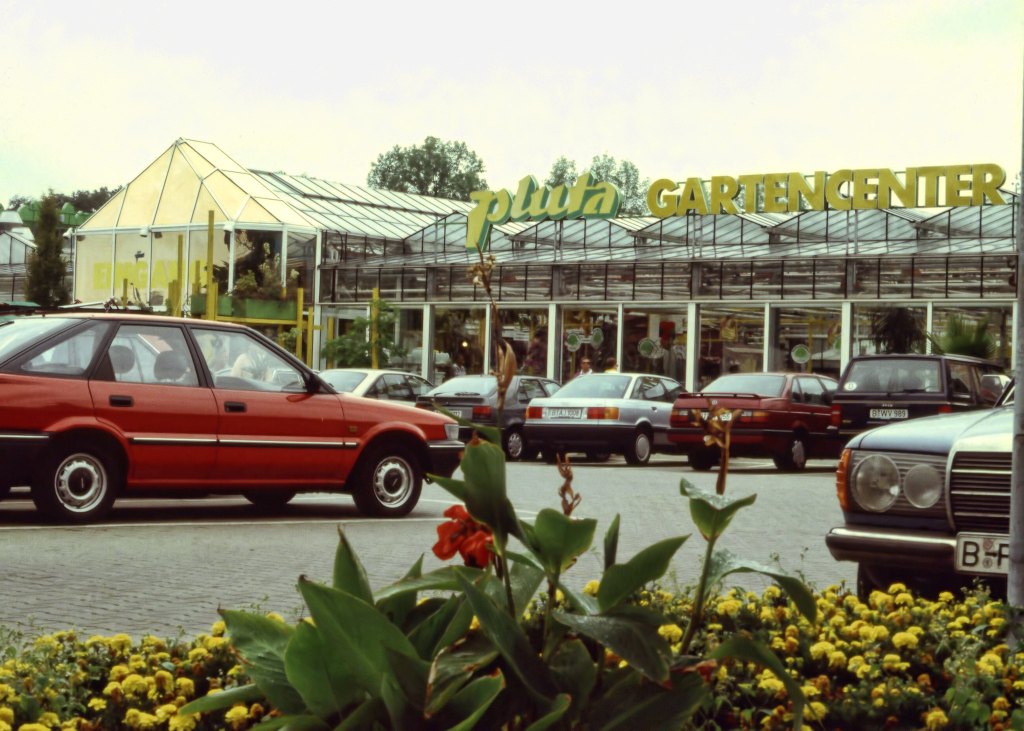
I was dropped off at the apartment block that was just up the street from the family’s business — Pluta Garten Center. So that was the ag connection. No farming to be done, but perhaps I’d end up helping replant flowers. Water plants in the greenhouse. Or I could learn how to run the forklift because I was obviously doing so well with my tractor-driving skills. We would see.
The apartment was used, as Carsten explained as he helped me carry my luggage, by the company when they needed to put someone up while there to train at the headquarters, or visiting execs, etc. But for now, it was home to an American.
##
For the better part of a week, I was living the dream. Okay, I had never ever actually dreamt of living by myself in one of the largest cities in Europe, but we don’t always get to pick which dreams come true. Sometimes it’s just best to come up with the dream after the fact.
My own apartment on the edge of one of the world’s most dynamic cities. A U-Bahn (subway) station a block away. And no work on the horizon for me. That’s not to say there wasn’t work being done. I imagine there was quite a lot, as the Pluta’s empire was growing quickly since the Berlin Wall had fallen. Carsten was nowhere to be found during the day as he was likely in his office at the Pluta Garten Center headquarters just up the street. We would meet around dinner and go out and about the city. On Saturday, we spent some time going out and about to a couple of their newer stores somewhere on the east side of the city.
Which left me pretty much on my own for most of a week, meeting up with Chris and Melissa in the morning to knock about the city, both planned and unplanned knocking about.
The following Tuesday, the host parents returned from holiday on Sylt, and I was moved out of the rather nice fourth-floor apartment and into their basement. Sounds like I was really downgraded, but this wasn’t the first basement I was going to live in while in Germany, as I had had a very comfy little room in the basement of family #2, the Höflichs. And this one was comfy as well, but just not very little. My new lodgings had their own entrance, and featured a queen-sized bed that sat in the back of the two-level room. The front part was a sitting area with a television. Other than the fact that the apartment had its own (mostly unused by me) kitchen, it was a move up, I’d say. I’ve rarely stayed in better hotel rooms.
It turns out, the room belonged to Marcus. Who’s Marcus?! Turns out, there was another host brother I had not met, let alone hardly heard about. Had he gone rogue and joined another garden center conglomerate, thus earning banishment from the Pluta empire? Had he gone mad under the pressure of living in such a nice room? Was he worried that some random American was going to drive a wedge between himself and his family?
No. He was in Dortmund working for one of their suppliers, learning about their business. He came home once for just a day while I was there and, to be honest, I can’t even say what we did when he was there. Probably went out for a nice dinner, I suspect. There were a lot of nice dinners in Berlin.
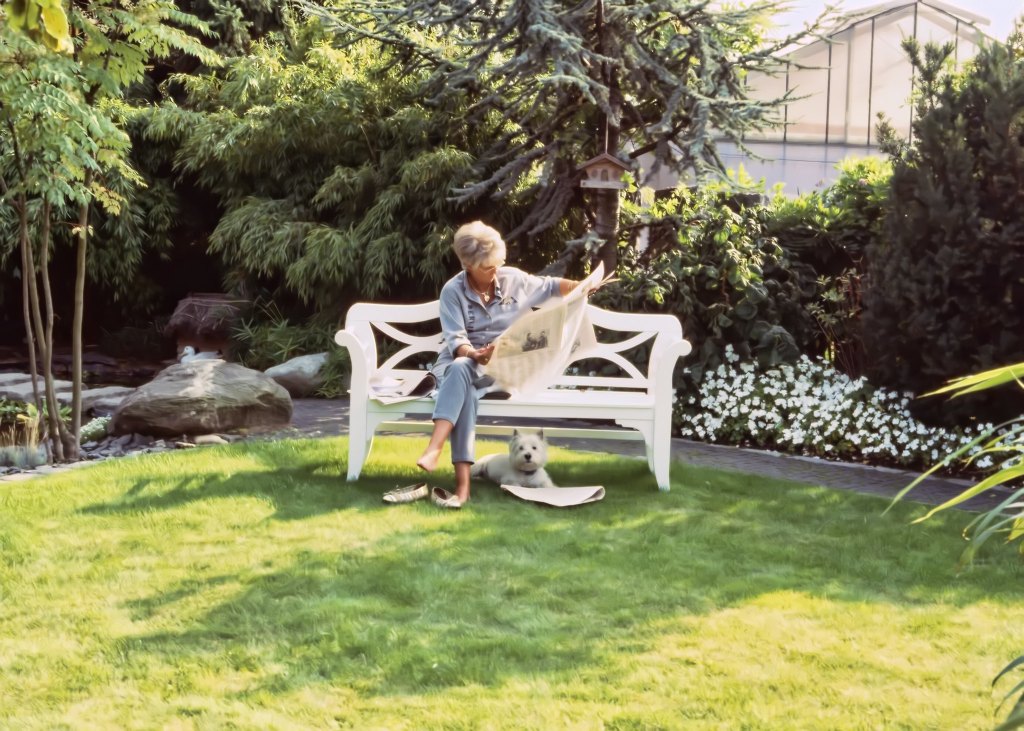
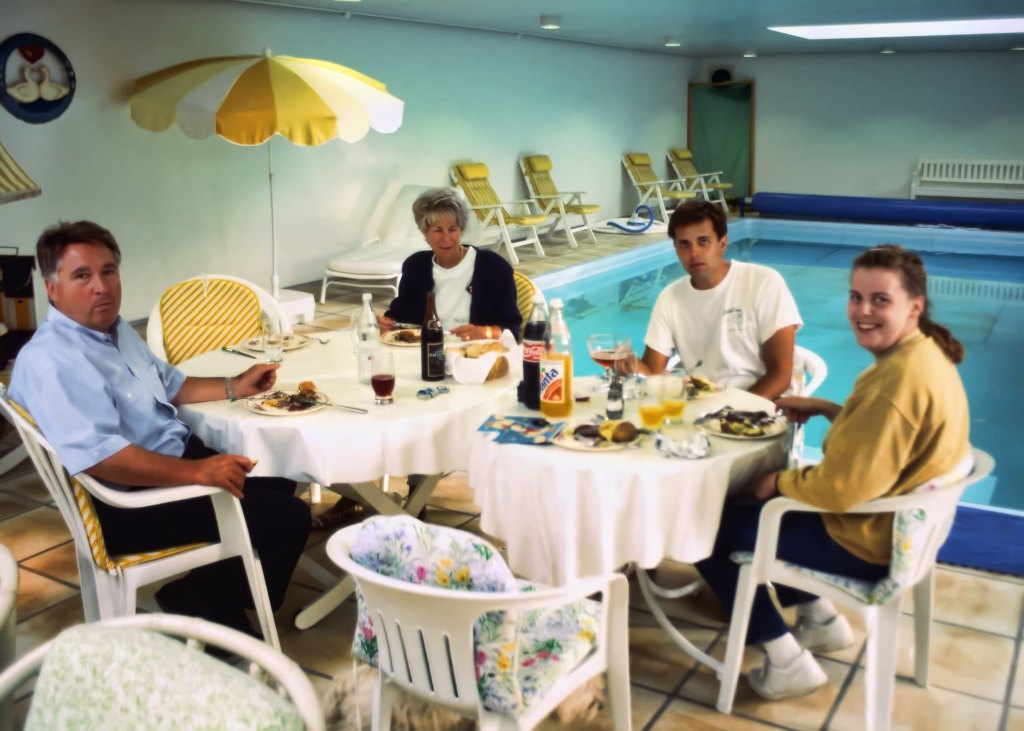
The house I now found myself in was elegant, and the amount of white paint that went into it is worth noting. White kitchen. White furniture. White pool enclosure. White gate leading to the red clay tennis court. White KPM porcelain pieces were scattered tastefully throughout. Never heard of KPM? Me neither, until the week before when one of our planned knockabouts was to KPM, Königliche Porzellan-Manufaktur (Royal Porcelain Factory). We spent an afternoon learning about the entire process of porcelain manufacturing at what could only be described as a very high level. There was a lot of hand trimming. Hand cutting. Hand painting. Hand gilding. All that hand handling added up to some very expensive pieces. Like all factory tours, the exit led to the gift shop. I carefully glanced at some of the price tags of the “souvenirs” they had for sale, as I did not want to knock anything over when I got startled by the cost. “The decimal is in the right place, is it?” I thought a few times, not realizing that a plate could have so many numbers to the left of the point. I asked if they had a box filled with broken bits I could root around in for something to take home. I couldn’t help thinking those folks breaking all that porcelain back in Appenweir for the couple’s wedding really missed out on showing off by breaking a few pieces of this stuff.
So I felt to be rather an expert at realizing the overall worth of the numerous vases, plates, and other pieces that decorated the house was significant. I kept my distance from all of them, thinking that, perhaps, any insurance the IFYE program had on me wouldn’t cover breakage at this level.
They arrived home, refreshed from their vacation and possibly real estate deal on the island, and promptly went back to work. I was left with the idea that a terrible amount of work was going on in their main office, just on the other side of the tennis court. I also got the idea that I would be about as useful there as I had been with milking cows at 5 a.m., and we know how well that had gone so far. Helga would likewise disappear from the house, as far as I could tell, though to do what, I couldn’t say. Of all of my host parents, I probably talked with her the least. She was always pleasant. Friendly. But quiet. I recall her having a real elegance about her.
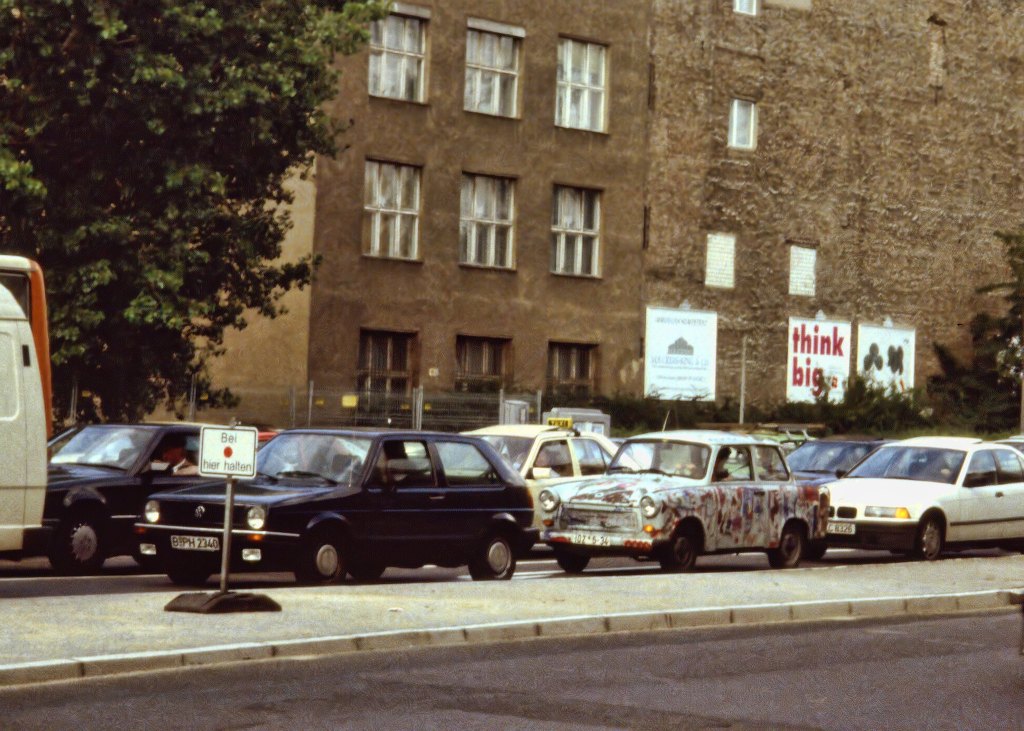
Hans talked enough for both of them. He was animated. Busy. Quick to explain anything, but mostly about how the garden center business was going these days, which was like a rocket. When the Wall came down, the Berlin market grew quickly, and the Plutas were on that like flies on sauerkraut. (Sorry – don’t like sauerkraut.) A lot of East Berlin was, to no surprise, pretty dull in appearance. I would cross a section of former East Germany going from the Plutas to where Chris and Melissa were staying, noting in my journal that you could tell when you crossed the now invisible line from West to East and back. There were no signs (at least not out here on the far southern edge of the city) that proclaimed “Hi! You’re in what used to be East Germany!” It was slightly more subtle than that. The houses were smaller and grayer. Did they not get the message about white paint? Roads were still cobblestone, bumpy enough to make a CD player in a Jeep skip when said Jeep was driven fast enough. Later, in the city center, the transition was often marked by going from buildings that didn’t have bullet holes to buildings that did have bullet holes and other damage left from WWII.
There was also less landscaping to be seen. Fewer flowers. Not as much shrubbery. Not even a decent bit of hedge. And in swoops the Pluta Garten Centers! In the three years since the wall came down, they had practically doubled their number of stores, moving into buildings in the former East Berlin, and starting to build new ones. They would, one way or another, make East Berlin look better!
I spent a few days traveling with Hans from store to store as he checked in to make sure that things were going well. Inevitably, we’d eat at some steakhouse, which seemed to be his preference over literally any other type of food. In the cellar of a Rathaus (town hall) somewhere on the outskirts of Berlin, was (or maybe still is) a small restaurant with, at most, a dozen or so tables. It offered, Hans assured me as we went down the steps and into the elegantly dimly lit space, the best steak I would ever have.
I have to say, when it came to steaks, the man knew what he was talking about.
Alas, I failed to note the exact name of the place in my journal, and I am likely never to find it again.
##
Cars are a big thing in Germany, especially when it comes to German cars. You may think the Ford/Chevy/Dodge thing is a big debate here, but just try to stop an argument between the Audi/BMW/Mercedes/Porsche devotees. Your best bet is to just give everyone involved in the argument a beer, sit them down, and say something like “Yeah, my 1988 Dodge Horizon is quite the marvel of engineering.” And then watch the beer fly.
The Plutas seemed to have resolved the issue by having one of each. They, for some reason, lacked an Audi, but made up for it with their other cars. There was the aforementioned BMW, whose exact model eludes my memory, mostly because it was the most “basic” of the rest of the vehicles in the family’s stable. There was a Mercedes sedan. A second Mercedes was the fabled G Wagen. If you don’t think you have seen one before, you probably actually have in any number of James Bond movies, or similar high-end productions. It looks like a tank and an SUV got together one drunken evening. It’s thick. Boxy. It sits high off the ground. The doors “clunk” shut the way only really heavy doors can. When it’s barreling down the road, as barreling is apparently the only way it can be driven, you hardly feel a thing.
Upon sliding into the passenger seat for the first time, and clunking the door shut, as Hans and I were about to set out for the day to visit a few of the far-flung Pluta Garten Centers, he asked if I had ever seen a Mercedes like this in America. I admitted I had not. I actually saw very few Mercedes in the small town I grew up in or the small town I went to college in. He nodded as if he knew what my answer would be. “That’s because they’re too expensive,” he informed me. All right then.
That leaves the top German marque, Porsche. And the Pluta family owned two of them. The first was an “average” Porsche 911 that served as Helga’s daily drive. She may not have spoken much, but she clearly knew what makes a good car.
It was a few days into my stay before Carsten brought forth his baby. It had been in the repair shop following an incident at a Czech race track a few weeks earlier while he was racing against his friend’s Ferrari Testarossa. (Yes, every word in that sentence is true.) It wasn’t just any Porsche. This one was quite special. This was the iconic Porsche 911 Turbo (technically a 964 to denote it was a special version of the 911 Turbo.) Big wheels on the back. Even bigger “whale tail” wing above the rear engine. I quickly learned that I could hear him coming a block away, and not because of some obscenely loud engine exhaust, though at full-throttle, it could be quite loud. It was the gurgle that gave him away. Every time he downshifted, say coming around the corner at the end of the block, the engine would give a pleasant gurgle, as if that last gulp of gas was especially satisfying, like a man leaning back after taking the last sip of particularly fine wine at the end of a wonderful steak supper.
And it was black, which was, in Carsten’s opinion, the only color a Porsche should be. I didn’t have the heart to tell him of the pink one I had seen in the Porsche factory lot back in Stuttgart. I didn’t want to be the bearer of bad news.
I got to tool around an iconic German city in an iconic German car quite a bit, as Carsten clearly loved to drive it (and perhaps show it off a little.)
In what is surely the most ironic thing to have ever happened to me, I somehow managed to spend nearly three weeks around this machine, often riding in it, and never once thought to get a photo of it, let alone a photo of me in it. I was just having too much fun being a passenger in it! And no, I never even considered asking to drive it. I know the IFYE insurance would not have covered that.
Oh, and a Jeep Cherokee (as mentioned above.) That comes into play next.
##
Since working in the Pluta office was not going to happen (I couldn’t even usefully answer the phones), most days in Berlin were filled with exploring the city with Chris and Melissa, who also didn’t have much work to do with their families.
I quickly became the driver for our group, as Carsten had lent me his Jeep Cherokee for my personal use. This was the first Jeep I had seen in Germany, as there probably weren’t many at the time. Carsten was glad to tell me that he had bought the Jeep in Miami, Florida, a year or so earlier while there to play tennis, and had it shipped over. The Jeep was, I suspect he was thinking, a vehicle that I could handle and be trusted with. It wasn’t overly powerful, or expensive, like the 911 Turbo. And, in hindsight, Carsten was pretty spot on.
It was a wet street. That’s really my only defense. The car in front stopped short and I slammed the brakes. BUMP. Crap. We both got out of our vehicles and looked at the point of impact. It was, fortunately, very minor, with a cracked taillight the only damage visible on her car, and nary a scratch on the Jeep. We looked at each other and smiled. Then I asked, in German, if she spoke English. So much for the smile. She didn’t speak English, and I knew enough (barely) by this point to say I was an American on an exchange program. Of all the times I could have “bumped” into a former IFYE, exchangee or host, this would have been a perfect time. We would bond over the shared IFYE experience. Had a laugh over the minor inconvenience of this all, and then gone our own way, each with his or her own story to tell others later on.
But it wasn’t, so that wasn’t going to happen.
Momentarily, though, a police car pulled up. Oh boy, I thought, we had been warned to mind our manners around German police. They weren’t known for a sense of humor. They stopped next to our two vehicles and surveyed the scene. The other driver asked if either one of them spoke English. This got a bit of a look from the officers, who shook their heads and pulled away, apparently off to find something happening that wouldn’t involve translating English.
We ended up finding a payphone nearby and I called Hans. “Guy, how is it going?” he asked. “Not too good,” I replied. “Oh. Had an accident?” was his actual response. I may have imagined the question mark at the end of his reply.
He showed up a few minutes later, in his Mercedes G Wagen, and any amount of damage the lady was going to have him pay, probably tripled in her mind at that point.
##
Berlin is a city full of history that lurks around corners, in the dark, waiting to jump out and greet you rather unpleasantly like a mugger saying “Good evening, may I please have your money?”
Berlin’s history is best taken in small doses.
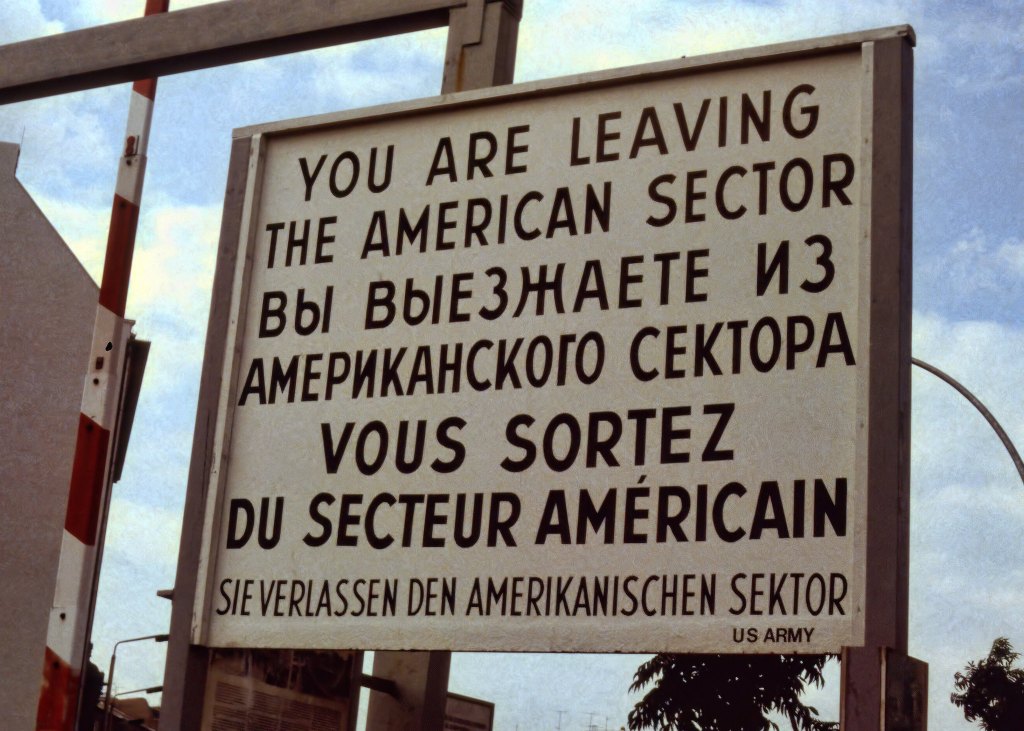
Chris, Melissa, and I toured a lot around Berlin. The routine became that I would pick them up in the morning and we would drive to a nearby U-Bahn station and, after deciding what looked interesting for the day, head into the city. We started with Checkpoint Charlie. At the time, that area hadn’t changed too much, perhaps a splash more neon on the East side of the checkpoint than had been there before. It was a narrow street and the checkpoint stood in the middle of the intersection. It was, as I recall, still actually manned by soldiers, who now just stood there and watched tourists saunter past the point where, just three years earlier, anyone else would have been shot at.
The Checkpoint Charlie Museum, just across the street, was a good introduction to the recent history of the city. It covered how the wall was built, and its effect on the city and the people, as well as the ways people tried to escape into the West, and not always successfully, a point the photos make abundantly clear. After a walk through the museum, I felt we needed a drink, and I still didn’t drink that much.
Since there was no one at the post to stop us, we wandered over to the East side of the checkpoint with a few hundred others and saw that plenty of Western stores (Benneton, Sony, etc.) were leading the charge to bring the East into the shopping world as quickly as they could.
From there, it was a kilometer and a half walk to the Brandenburg Gate, which was now open for traffic and teeming with, it seemed, literally anyone with a piece of history to sell to you. Need a Russian military hat? They got it. Russian military medals and insignia? Yep. Chunks of the Wall that looked suspiciously like a piece of sidewalk they picked up from the front of their house? Name a price!
The place was busy with tourists, dodging cars, buses, and sidewalk salespeople. It once stood just behind the Wall, and had been off-limits for nearly 30 years. But in November 1989, it suddenly became accessible to those from the East and West. In 1992, much of the ground that had been just behind the wall stood out like a scar that tore through the city and countryside. The East Germans had cleared out the land behind the Wall, or abandoned the buildings near enough to allow sightlines across the border, and much of this area was still barren. Step through the gate heading West, and look north and south, and all you would see was a partial, recently paved street. Piles of rocks (not the Wall). A few new buildings. And a lot of construction.
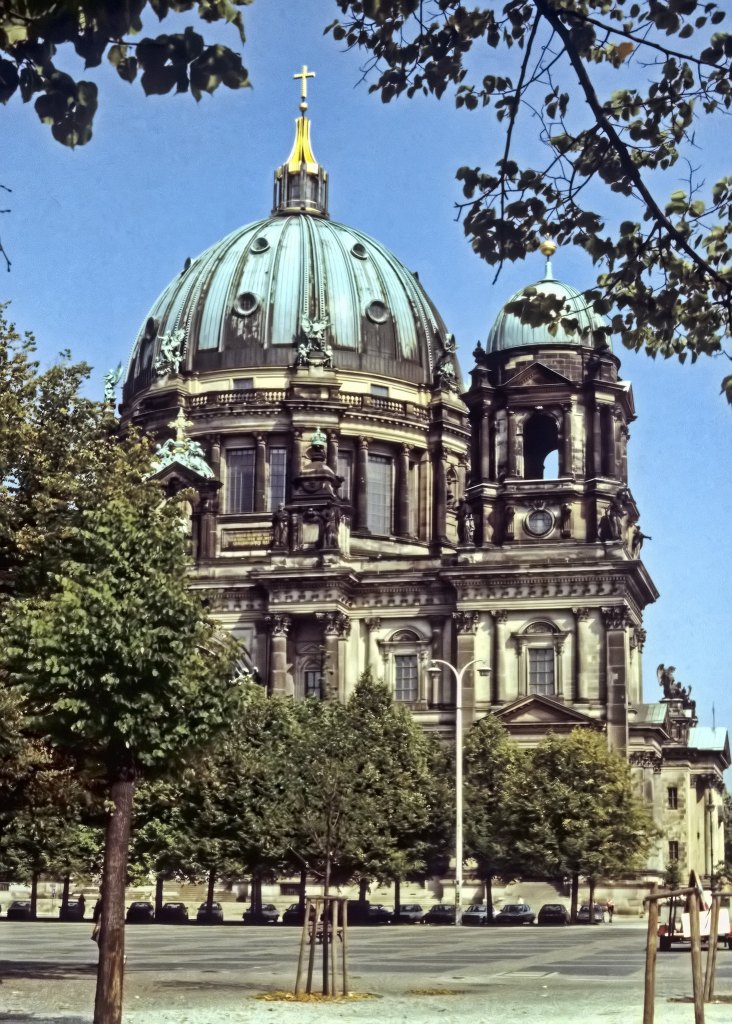
We had a few tours planned for us by the Landjügen program, and a three-hour tour, which did include a boat ride, but only on the River Spree, served to give us ideas of places we wanted to return to, such as the Berliner Dom and Museum Island. It was also fortunate that we had a few days of exploring on our own and had become adept at using public transportation, as our guide managed to not make it onto one U-Bahn train that we managed to board. I don’t recall why she missed it, but we got on the train and the doors closed with her still on the platform. We just waved to her as she stood there, mouth agape, watching her three charges from America leave without her.
##
We managed to find a few off-the-beaten-path places to explore. One of the stops on a tour was the Soviet WWII Memorial, which was massive and had a solid brutalist vibe to it. Another that we found on our own was the “Museum of the Unconditional Surrender of Fascist Germany in the Great Patriotic War” (translation – a museum that looked at the defeat of Nazi Germany by Russia.) This was deep, deep into East Berlin. So deep, in fact, that there were still Russian troops there that had yet to return to Russia, who were just walking around. Definitely an interesting stop as it showed just how history is seen from another point of view. It was also the building where the Germans formally surrendered, ending WWII in Europe.
Berlin is filled with such sites. Off the beaten path, both literally and in the history books. Only a deep dive into German, WWII, and Berlin history might discuss these locations that are away from most of the tour bus stops, restaurants, and shopping areas.
Then there’s a place like the Maifeld. This large field sits adjacent to the Berlin Olympic Stadium, the site of the 1936 Olympic Games. At the west end of the field stands a large bell tower and a quarter-mile-long stone viewing stand. During the games, it was used for field events like polo. Following the Olympics, the site was used for massive political rallies. You’ve probably seen the historic photos from those events.
And here we were, in August 1992, having a pre-game party before going into the stadium to watch an NFL game. History is just warped, sometimes.
Of all the things we ended up doing in Germany, attending an NFL game between the Miami Dolphins and the Denver Broncos was probably the oddest. It was the “American Bowl,” preseason game that brought both teams to the city, and the players who bought all of the XL (and XXL and XXXL) shirts at the Berlin Hard Rock Cafe. All three of us joined Carsten for the pregame party, which was a lot of people standing around on a historical site doing about the complete opposite of what had, historically, been done there. Basically having a good time.
Then we headed over for the game which was, based on my limited knowledge, a pretty typical NFL game. I failed to note in my journal who won, but the Dolphins were the crowd’s favorite. They brought their cheerleaders.
The halftime show consisted of a program that highlighted the effort of some Berliners to bring the 2000 Summer Olympics to Berlin. And as exciting as that sounds, the city was, at least in the stadium that night, clearly divided on the issue. Why not have the Olympics in your city? Well, apparently even back then they weren’t cheap to host. Or even bid on. Or even think about. And a lot of people felt the money could be better spent on things the citizens of Berlin, East and West, needed, rather than a bunch of stuff for international athletes.
But I knew that if Berlin was awarded the Summer Games, I would do everything I could to come back to watch them. Turns out, Sydney got the 2000 Games, and I and my family went there to watch them.
Sorry, Berlin.
##
There were plenty of other places to see, historic and otherwise.
Historic sites included the Sanssouci Palace, which translates as “No Worries” – a term I am very fond of; Cecilienhof, where the 1945 Potsdam Conference was held that led to the eventual dividing up of Germany (and all the issues that caused); Schloss Charlottenburg, another castle that looked amazing on the outside and just like all of the others on the inside; the Pergamon Museum, situated on Museum Isle, and was still riddled with bullet holes and other damage from WWII; and a very nice coffee shop along the historic Kurfürstendamm, or Ku’damm, as the locals called it.
That last was on a relaxing Sunday morning with Carsten, one of many places he or Hans took me to sit and eat. Among all of the hustle and bustle of touring the city and seeing the historic sites, it was clear that I was comfortable “living like a German.” The morning was warm, but not hot. No plum-picking humidity here. The coffee was good but expensive, so it was a good thing that Carsten was picking up the tab.
If you had had the good fortune to have been strolling that fine Sunday up the Ku’damm, and had glanced casually off to the side where a cafe was set up out on the wide sidewalk, knowing that the only way to glance in this situation was casually, then you would have seen what appeared to be two German men sipping coffee and looking at their respective newspapers. But you would have been fooled. One of them was an American, reading an English newspaper (which might have tipped you off, had you been paying attention.) I didn’t have a camera hanging around my neck. I wasn’t gawking about. For all appearances, I was just a German in Berlin, enjoying a sunny Sunday morning.
Just as long as you didn’t actually ask me anything in German.
##
Living in a massive city like Berlin did provide plenty of opportunities for experiences that I never would have back in my hometown, which, at the time, had a population of around 8,000. Fortunately, the U-Bahn and S-Bahn (street cars) system allowed us to get around easily enough. It was my first real experience with Urban public transportation for any length of time, and it was a bit of an eye-opener.
Two incidents that stood out for me on the U-Bahn (other than the time we lost our tour guide):
Chris, Melissa, and myself blended in fairly well with the Berlin populace, until we spoke. Due to my limited German, we spoke English when it was just the three of us, which did make us stand out to anyone paying attention. Apparently, one lady had been paying attention.
There was nothing remarkable about her. She had been sitting quietly across from us and down a few seats. She hadn’t been making sudden, erratic movements. She wasn’t carrying around a stuffed pet named Brandt, whom she would pet and talk to softly. No outward signs that she might be a little off.
That is until the train pulled into a station and she stood, preparing to disembark. She turned to us and asked “Ich bin Americaner?” Chris told her we were Americans, yes. “Sprechen sie Deutsch?” Chris said, yes, we spoke a little. She then proceeded to rant at us, in German, naturally, for the full half-minute left before the train came to a stop. As the doors opened, she gave a snappy little nod, as if to say “And that’s all I have to say about that!” And marched right off the train.
We looked at Chris for a translation. He had no clue. But a couple of other ladies who both looked normal and were normal, who sat across from us, began laughing. Whatever it was, it must have been weird.
The other memorable event actually happened a few times, with varying degrees of success. It involved someone standing in the middle of the car and clearing their throat to get everyone’s attention. Or sometimes just shouting “Achtung!” To which I had to resist shouting “Baby!” right back at them. (See the previous chapter and the U2 connection here.) They would make a short announcement, which went over my head. And then they would do one of three things: start playing an instrument, normally a small, handheld instrument (and fortunately, never a bagpipe); sing, usually pretty well; or just walk up and down the train car with a hat, bag, or purse held out taking donations.
##
Halfway during my stay in Berlin was the halfway point of my time in Germany. And, despite my joking to the contrary, I was starting to pick up more of the German language every day. It was also apparent that my viewpoint was changing as I didn’t look forward to seeing the sights as much as I looked forward to spending time with my host family. They took me to the places and restaurants, especially restaurants, that the tour books didn’t bother with. And I enjoyed the company.
Yet, despite how pleasant the Plutas were, and how packed Berlin was with things to do and see, I was looking forward to getting out of the city, and back to a more rural lifestyle. Because, as we all know, there’s nothing quite as relaxing and slow-paced as a farm. Right?
 One Guy's Writings