Or how one word tripped me up for 30 years
by Guy Thompson
Editor’s Note: The last couple of chapters are going to be slightly shorter than the others. This isn’t because I didn’t have fun or enjoy my time with the final two families or didn’t do anything of interest. Quite the opposite, I’d say. I continued to enjoy living with the families and learning from them. It’s just, for the last six weeks of my time in Germany, things were significantly more normal. That is, much of what I was doing had become normal. Living/working on a farm – normal. Seeing important, or sometimes obscure, places – normal. Castle? Seen ‘em. Gasthaus? Ate there. German word? Mangled it. Just another day, really.
The end result was I did less, a lot less, writing in my journal, and since that is how I am remembering the vast majority of what I did, you can understand why these chapters are going to be shorter.
##
Now, this was different. If we didn’t get off the train now, we would end up on a large boat.
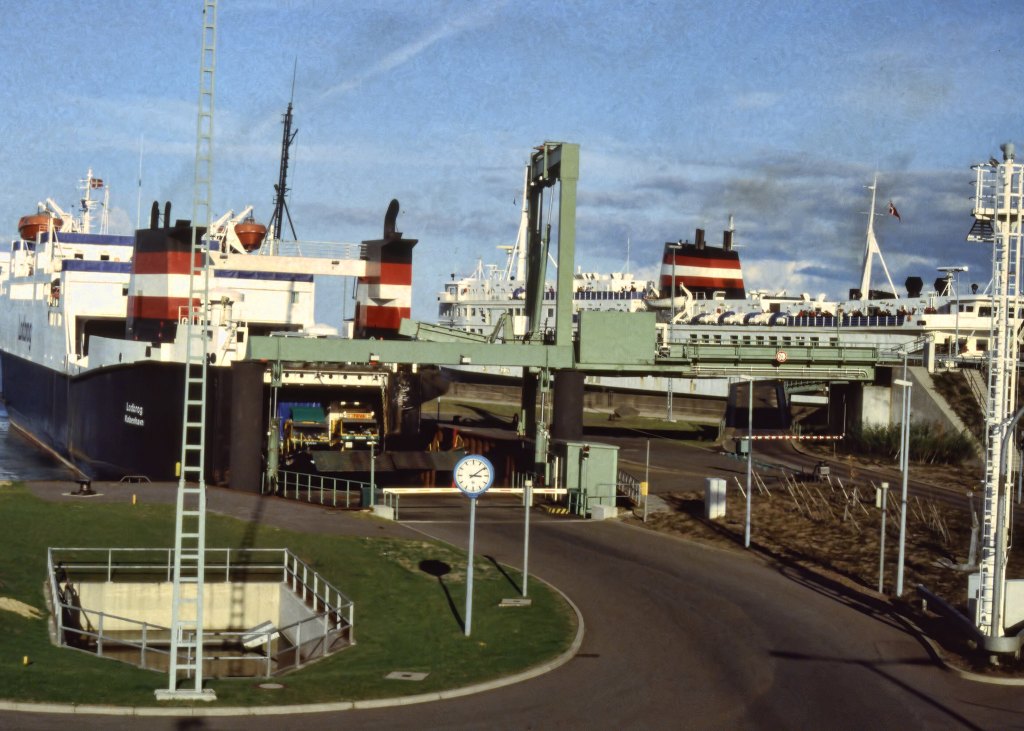
The train we had taken to our next-to-last host families was stopped at the Puttgarten Bahnhof (the whole affair was too small to be a Hauptbahnhof, as “Haupt” denoted something was the main one. I.e., Hauptbahnhof = main train station.) The town of Puttgarten itself was a kilometer away from the station, which was right up against the northeastern shore on the island of Fehmarn. Our train from Frankfurt (along with a change in Hamburg, which we almost managed to miss) had crossed the Fehmarn Sound Bridge a few minutes earlier and began to slow down as we crossed the island, coming to a stop at the station, which looked like a lot of other small-town stations.
Except, just ahead of the train was a very large ferry, the tracks leading right up to the back of it, and, in a few minutes, the train would roll onto the lower deck of the ferry and cross this far southwestern finger of the Baltic Sea on its way to Copenhagen, Denmark. The whole train. Along with cars, buses, and semis that were waiting alongside the train in their own lanes. Short of going up through the small bit where Germany and Denmark connect land to land, this was the main route north.
We weren’t cleared to go to Denmark yet, so we disembarked and met our sixth host family. And for the first time, I was sharing a host family with Chris. He arrived separately, returning from Norway, where he had spent his free time.
I bet Norway wasn’t on strike.
##
The Mackeprang family had a farm a few kilometers west of the ferry dock, along the northern part of the island. The farm itself was very neat and tidy – a large house that sat hidden from the road behind a large barn. Harvested fields surrounded the entire affair.
Host father Hans, host mom Elke, and host sisters Katrine and Itte, along with host brother Carsten… (Hang on. Let me check my notes. Yep. Carsten #5!) Anyway, the family farm in this far northern German outpost appeared to make most of its money with tourists. Not harvesting them, but renting out rooms in this house and two others down the road. They owned a campground that sat on the water’s edge, looking out over to Denmark. And they rented out space in the barn for campers and boats that the tourists didn’t take with them when the weather turned colder.
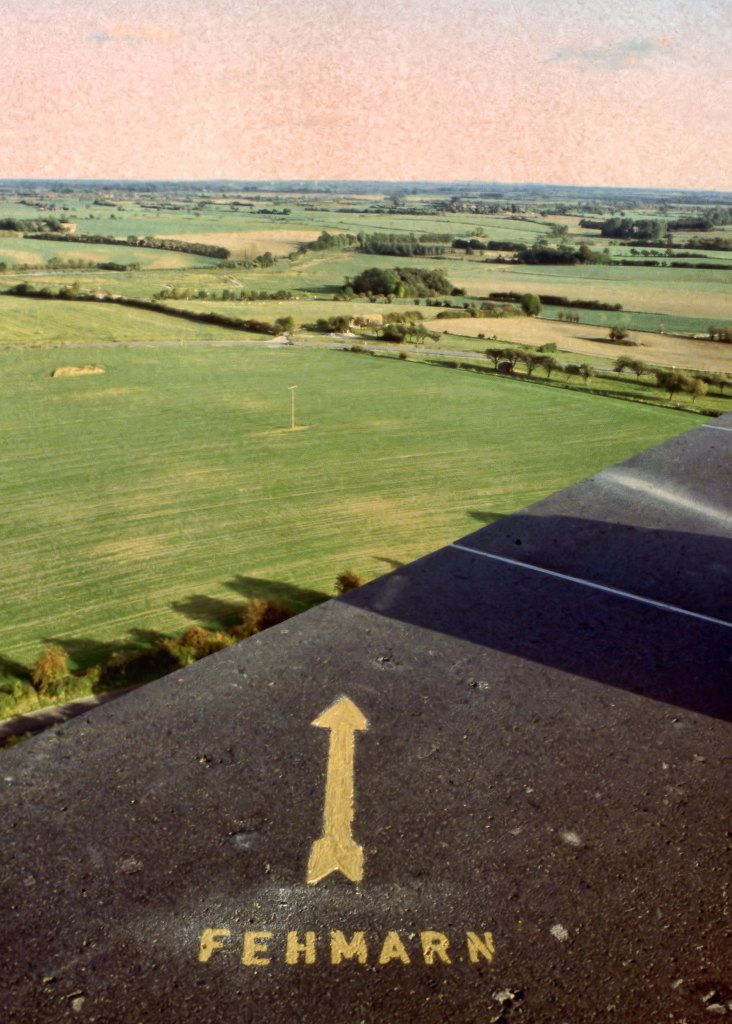
And it had turned decidedly colder. We were just south of Denmark, which lay across the waters of the Fehmarn Straits, at the farm southwest tip of the Baltic Sea. This was a place where the wind was so strong and steady that trees all leaned noticeably to the east. The island had a full complement of electricity-producing windmills.
The Mackeprangs did have some agriculture going on. They farmed the surrounding fields, and harvested beets, and other crops. But by this time of year, the harvest was pretty much done. There were a few cows scattered here and there among their fields, which we got to chase.
Allow me to clarify that. We, host dad, host brother Carsten, Chris, and I, took a trailer down the road to one field to load up two cows who were pregnant and set to deliver their calves at any time. They preferred to have the cows do this up at the barn, which would be better for them, as well as the cow and calf.
As noted earlier, it’s pretty easy to get cows to move where you want them to. However, catching them and putting them into a trailer is another thing altogether. The four of us worked to coral the cows, and here I was actually helpful since I still had some speed and endurance from all of my years of running. I zipped around the field, actually having fun doing this. Cow chasing – coming soon to an Olympics near you!
We got one cow in the trailer and turned our attention to the second one, which proved to be more challenging than the first. We finally got her corralled in a corner, ready to move her toward the trailer when someone noticed a small calf running around in the far corner of the field. The cow had already given birth. Oh well. We took the one cow we had and headed back to the farm.
##
When we weren’t chasing cows, we did a fair bit of traveling, reverting back to “tourist” mode for a while. We hit places like Hamburg, and Kiel, where we met up with Itte, who was going to university there.
It was also interesting to be in the same family as Chris. After five months of being, more or less, by myself, it was a real change of pace. For starters, he was very fluent in German, and actually even better than when we had first arrived, which I hadn’t thought possible. I was still doing the German equivalent of “See spot run. Run, Spot, run.” Chris could converse in German on about any topic, though most of the topics seemed to revolve around alcohol. Our host brother, Carsten (#5), also enjoyed conversing on these topics quite a bit. It wasn’t unusual for us, or sometimes just the two of them, to head off to the local discotheque, where the music was as loud as the dancing lights were bright, and the drinks were on sale.
As a side note: Chris was also a pretty smart guy and had just graduated from MIT. As well as this being an impressive accomplishment, he also had a great sweatshirt that had “MIT” across the front. In German, mit means “with,” so he had a sweatshirt that, to the Germans, just said “WITH.”
Up until this point, I had, overall, been feeling a bit better about my German language skills. Well, using the word “skills” may be pushing it a little. More like German-ish. I knew a good number of words, beyond just the basics “eat,” “morning,” “nacht,” and more. I could almost hold a conversation in German. Almost. As long as the person I was speaking with didn’t mind having to weave their way through the minefield of horrendous German grammar I was attempting to use, we could talk. But usually, after a few minutes of having to listen to, and decipher, my German, the other person would almost always insist on switching to English. “So I can practice my English,” they would tell me. Sure.
Yet, there was one word I was especially having trouble pronouncing. And it really shouldn’t have been that tricky as it was the name of the island I was living on – Fehmarn. At the time, I don’t recall pronouncing it any differently than anyone else around me, native Fehmarn residents or otherwise. But apparently, I had been horribly mispronouncing that word. For years after my travels, when talking with people about my time in Germany, especially those from Germany, I would get quite a blank look when I said, “And I lived on the island of Fehmarn.” I was pronouncing the first syllable like “Fay.” Fay-marn. Easy.
It was only in the past year, while watching a video on the island and a new construction project that may make loading trains onto a ferry obsolete, that I heard how the word should be said, with the first syllable pronounced “Fee.” So – Fee-marn.
That slight mistake has left a 30-year-old trail of confused looks and misunderstandings. Oh well.
Still, I worked on improving my German, adding a word here and a word there. My favorites were the words that, when translated into English, just seemed to make perfect sense. The german word “Hochzeit” means wedding. But the literal translation comes out as “high time.” Perfect! I know my fiance and I were looking forward to having a high time at our wedding, minus the dangerous dancing. And beer. And breaking porcelain.
##
Since we could literally see Denmark from the fields we weren’t doing a lot of work in, we took the opportunity to travel there for the day. We hopped on a train in Puttgarten and sat there while it was pushed onto the ferry. Then we got off the train and went up top for the 45-minute trip across the straits to Denmark, and then onward to Copenhagen. As I recall, we were a little under-prepared for a day trip to Copenhagen. It was basically decided that day that we should go. We were seasoned travelers, so off we went!
It was a lovely city. We caught the changing of the guard at a palace by accident. Found a neat pizza place to eat lunch by accident. Found the Tivoli Gardens by accident. Turns out this historic amusement park was closed, so we got a few pictures of the wood fence blocking our view of the gardens and rides.
As an interesting point of personal history, Copenhagen remains the furthest north I have ever been.
##
As usual, time flew because, as usual, we were having so much fun, even if my journal entries don’t prove it. And somehow, along the way, we had lived with six of our seven families. So now, as October edged towards November, and the cold winds began to cut across Fehmarn Island, it was time to hop on a train that had just come off the ferry and head south.
One more family. One more farm. One more chance to become a part of another family.
Oh boy.
 One Guy's Writings