Or how do I convince you I still don’t like beer?
By Guy Thompson
There is a very odd gap in my memory at this point in time.
I left the Glüßing-Lüerßens on Sept. 17. It would be Oct. 10 before I would write in my journal again. Hence the memory gap and why this next chapter is based solely on what I can actually recall and not off of any notes.
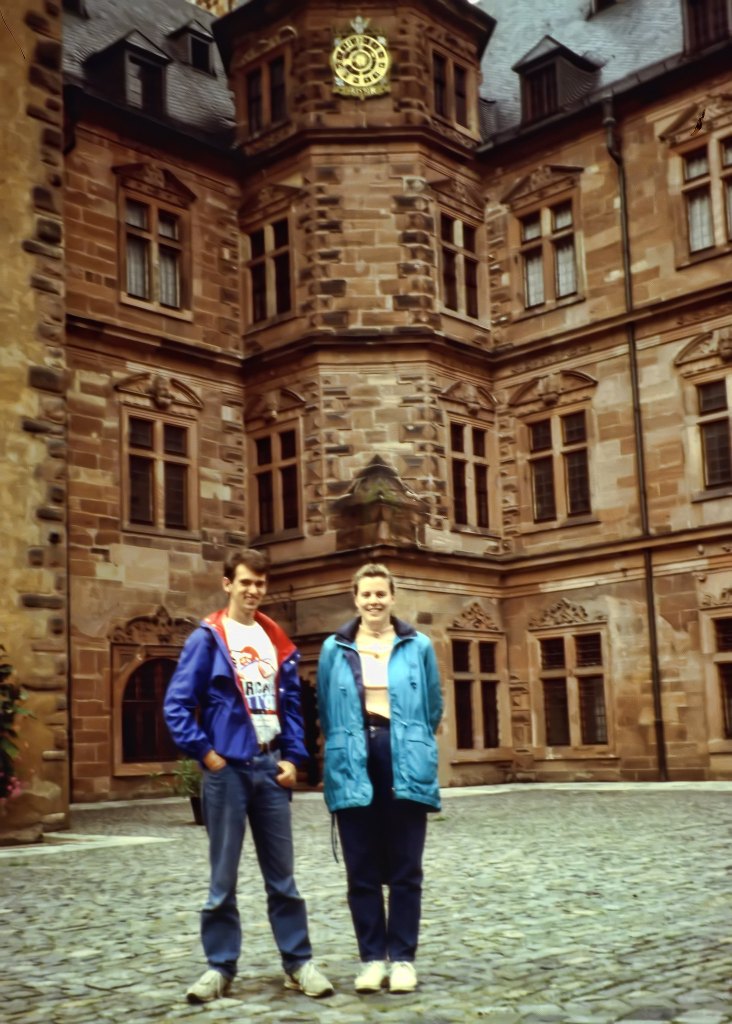
The photos help.
##
Melissa and I met up with Christopher in Hanover for our halbzeittagung – a half-time meeting with the head of the Landjügen to go over how things had been going so far. This was odd as, up to this point, we had hardly heard a peep from them. In fact, back with the Höflichs, Peter had to make multiple calls to the Landjügen offices in Frankfort, asking them where our passports were. We had left them in Frankfurt shortly after arrival so that they could get our visas finalized.
That was the level of organization we were dealing with.
The meeting was held in the Herrenhausen Gardens in central Hanover, which had a small castle and a large, well-manicured garden. We had most of our meeting out in the garden, among dozens of nude statues, interrupted a few of times by people wanting to take what can only be described as inappropriate photos with said nude statues. Some people are just really into art.
The meetings were scheduled for two days, but we only needed one as everything had been going pretty well. With nothing else to cover (and to be honest, I have no recollection of what we did discuss), we were told we could start our free time then and there. Our schedule gave us eleven days to travel wherever we wanted to, and with a Eurrail Pass in hand, there were a lot of places we could go. All we had to do was to be at our next host family on Sept. 30.
##
Christopher had decided he was heading north to Norway to see a former exchange student he knew. This was going to involve a 24-hour ferry boat ride, so he was anxious to get going. We saw him off at the Hanover Hauptbahnhof late that night before returning to the hotel rooms the Landjügen program had procured for us.
The next morning, Melissa and I headed south, passing through Frankfurt, and meeting up with the Höflichs. There we formulated a plan of where we wanted to go and also left about half of our luggage with them. It was time to travel fast and light.
##
Train stations can be just as interesting as airport terminals. People passing through, heading from here to there and back. With the right ticket in hand, one can travel anywhere. The Frankfurt Hauptbahnhof is certainly one such place. From there, travel to literally anywhere in Europe is possible. We considered traveling to Istanbul, for example. However, that would have taken up well over half of our travel time just on trains, and we wanted to get back to the Höflichs, who promised to take us to Oktoberfest.
In the end, Melissa and I decided on a circular route, heading to Salzburg, Austria, first.
While trains are great means of transportation, you are stuck with their timetable. Mostly that’s good, but the first leg of our trip from Aschaffenburg to Salzburg included a long layover in Munich, long enough that we considered sleeping there, but as much as I like train stations, I didn’t think sleeping in one was the way to go. Still, we got into Salzburg late. Very late. Late enough that where we actually were going to sleep became a pressing issue. Fortunately, some fellow travelers had a handy travel guide to Salzburg and had already found what was, according to the guidebook, a rather comfy youth hostel not too far from the station. So, with luggage rolling behind us over the cobblestones, we trudged off into the dark to find these fabled lodgings. Turns out, the hostel was part of a church campus. And it was affordable. And very comfy. And quiet.
Until 6 a.m.
That’s when the church bells started to ring. Every quarter-hour. And there appeared to be no snooze button. Trust me. I looked.
So up and at ‘em!
What does the budget-minded traveler do while in Salzburg in order to maximize his or her limited time and money? One does the “Sound of Music Tour,” of course. Complete with a non-stop sing-along with every song from the movie. And I’m not joking when I say every song… non-stop. During the day, we climbed every mountain, in the comfort of a tour bus; forded every stream, stopping to take pictures on the other side; and followed every rainbow until… sorry. Song got stuck in my head. But we saw, from a distance, the mountain top where Maria began her song and dance number. We also saw the convent where she finished the same song and dance, some six miles away. Not only could she sing, but she sure could run! There were stops at the Mondsee Kirche (church), used for the interior scenes for the wedding scenes (only singing, no dancing). The two houses for the VonTrapp family home where they sang and danced. The gazebo where they sang and danced some more. The fountain where they sang and danced with all of the children. And an Alpine slide ride that probably wasn’t there at the time for them to sing and dance on, but we had fun on it.
The guidebook that had recommended the tour did warn us, though. It called the tour “orgasmic,” although neither one of us would have agreed it quite reached that level. The book also added, “For those who found the movie to be about a domineering father with an unhealthy fetish for nuns, the tour is probably a loss.” The bus was filled with tourists, primarily Americans, who clearly didn’t see the movie in that light. The Austrians, however, were more than a little confused that we had any interest at all in seeing these places. After all, this was where Mozart was born. Didn’t we want to see that? To the Austrians, according to the Australian tour guide, this was just an American movie that was shot here. The VonTrapps were not, historically speaking, that big of a deal to them. Nuns or otherwise.
##
Man, Florence, Italy, is loud.
Melissa had a cousin who lived in Florence and had made arrangements to visit them if we could. We decided to skip another night under the belfry and booked a sleeper car for an overnighter to Florence from Austria, planning to get our sleep on the way. It ended up being more like sleeping between stops at each station along the way, as the train would shudder and jerk as it stopped, sit still for a few minutes, and then shudder and jerk as it accelerated out of the station. I would doze off briefly before the train arrived at the next station. And so on.
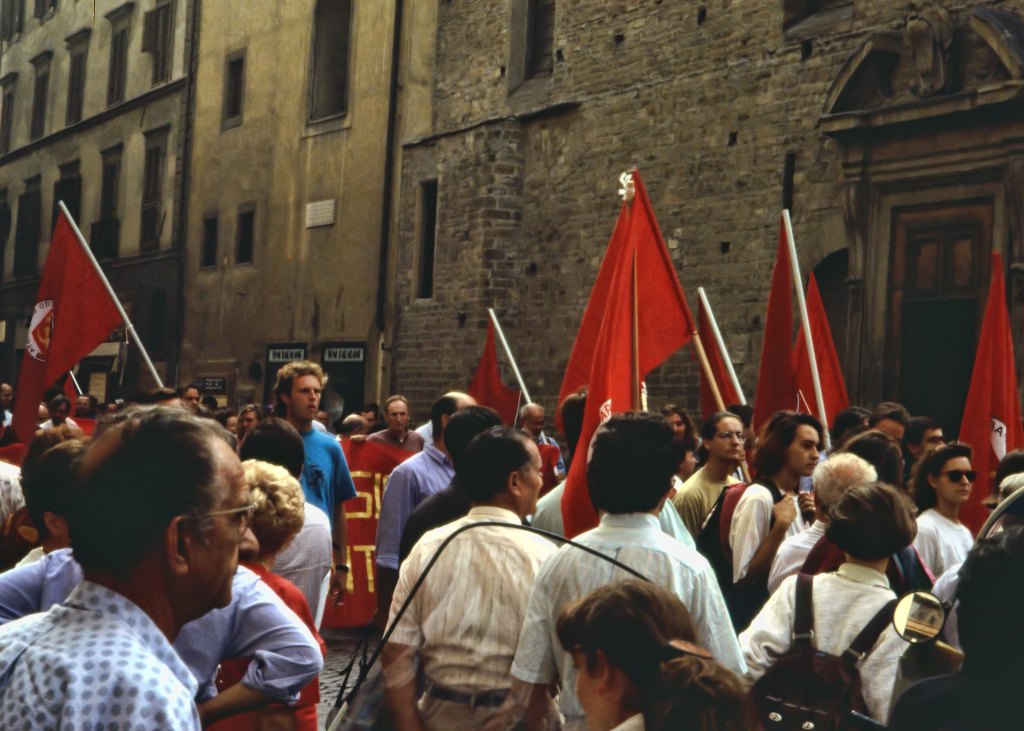
So it was that we arrived that morning in Florence not exactly at our best. We staggered out of the train and right into a strike, hearing the protest well before we could see it. Shrill whistles. Banging drums. Lots of shouting. Then we saw the banners held aloft by the people marching through the station, banging drums, shouting, and blowing their whistles. It passed by, and we headed for the restrooms.
Turns out, the restrooms at the time in Florence were rooms with little holes in the floor.
Earlier on, I had talked about culture shock and how it never reared its ugly head in Germany. Apparently, we had been so taken in by the German culture, so comfortable with the whole “live like a German” thing, that going into the Italian culture triggered a mild case of culture shock for the two of us. The hole in the ground (sorry, toilet) was the first indication that we were not in Germany anymore.
Inside the station was a tourist office and we stopped there to find information on a place to lodge for the night. A youth hostel was suggested, called, and booked. So far, so good. How do we get there? Bus? Unlikely. They’ve joined the public workers who were the ones who just marched through the station on strike, and only a fraction of the buses were actually running today, so good luck there. Taxi? Nope. Same reason. Fine. We’ll store our luggage for a bit and go sightseeing. Could they recommend a good museum to start with? Yeah… no. The museums were also closed due to the strike.
I’m all for solidarity, but this was getting ridiculous.
Melissa and I headed outside to see what we could find that wasn’t on strike. We were immediately turned around with no sense of direction. Traffic swirled around the square just beyond the doors. There was a church steeple across the way. Was that the large cathedral we had read about? According to the brief tour booklet, one of the most outstanding sights in Florence is the Cathedral of Santa Maria del Fiore. Unfortunately, the tiny map on the brochure did little to point us in the right direction.
There is no shame in asking for directions. I don’t buy into this myth that men can’t ask to be pointed in the right direction. I do it all the time. I had been doing it quite often in Germany. So had Melissa. As always, the first thing to do when in this situation is to establish the language the question and directions shall be delivered. Throughout Europe, it can be any one of a dozen languages at any given time, depending on the place and size of the city. Being Florence, a major historical and metropolitan site filled with tourists, the odds should have been good that we could find directions in English. We were already outside of the station, so going back into the tourist office seemed, for some reason, out of the question.
We probably should have gone back inside.
Melissa decided she would ask for directions and caught the eye of a gentleman, Italian, we assumed. She politely asked, “Sprechen sie Englisch?” He gave her a very odd look before shaking his head and quickly slipping past us and hurried off so fast, I could only assume he suddenly found himself late for a very important meeting. Melissa shrugged. I pointed out to her that she had just asked an Italian if he spoke English… in German.
I think it is safe to say that we were both missing Germany at this point.
We finally made it to the cathedral and were allowed in, though barely. Signs indicated how one should dress for such a significant place, and we just made the cut. If we had been wearing shorts, I think we would have been stuck with just looking at the exterior. It was, at that time, the largest church I had ever seen, filled with art, history, and historical artworks. It is the burial site of two popes and loads of historical figures. I’m actually getting all of this thanks to a quick poke about Wikipedia at the moment because, at the time, we were just glad to be inside (Florence was a lot hotter than northern Germany!) and away from the din outside. The strike had caught up to us again out on the street that went around the cathedral.
Even without a tour guide, who would wander past us, leading small groups that strained to hear them speak, as they were apparently limited to hushed tones within the cathedral, we could tell there were a ton of interesting things to see.
We found a couple of empty seats in a pew and sat down, overwhelmed by it all.
Being a tourist wasn’t fun at all. It was so much more fun to be part of a family that took you places that didn’t have busloads of tourists (usually). They knew the best places to eat that weren’t American imports. They could tell you what was interesting about the place, even if it took an English-German dictionary to do so. But being just a tourist sucked.
We finally regained our senses, wandered around the duomo, and went back outside.
We got lucky a little while later and found a bus that was running and took it to our youth hostel, which was a good thing, as the hostel was way up a hill. We stowed our luggage and contacted Melissa’s cousin.
It was thanks to Melissa and her cousin that Italy was able to redeem itself. We went to the cousin’s small apartment (the reason why we were staying in a hostel and not with them – no extra bedrooms) for a lovely dinner. Nothing fancy, some spaghetti, naturally, Italian wine, and plenty of conversation. I also managed to successfully twirl the spaghetti around my fork, using the spoon/fork twirl method, a feat I had not been able to figure out all of the times I had tried in Germany. Apparently, one must eat spaghetti in Italy to learn how to do so properly. And thanks to this experience, I can now show off my ability at any given time, but usually at an Olive Garden.
Hey, it’s the little victories that count.
##
The lovely dinner aside, we were both glad to be getting out of Italy. Well, we tried to get out of Italy. The strike was going into a second day and was starting to affect the trains, too. Our straight shot from Florence to Luzern, Switzerland, turned out to be a day-long detour that took us out to the Mediterranean coast before turning north. We actually got to see Pisa… the train station, where we sat for quite a long time. The Milan train station, too. A highlight was the opportunity to see the coastal towns from time to time. I could have stayed in one of them for a while.
Another late arrival spat us out at the station in Luzern. We were tired from the long train ride and still a little irritated by the overall experience in Italy, but glad to be in Switzerland.
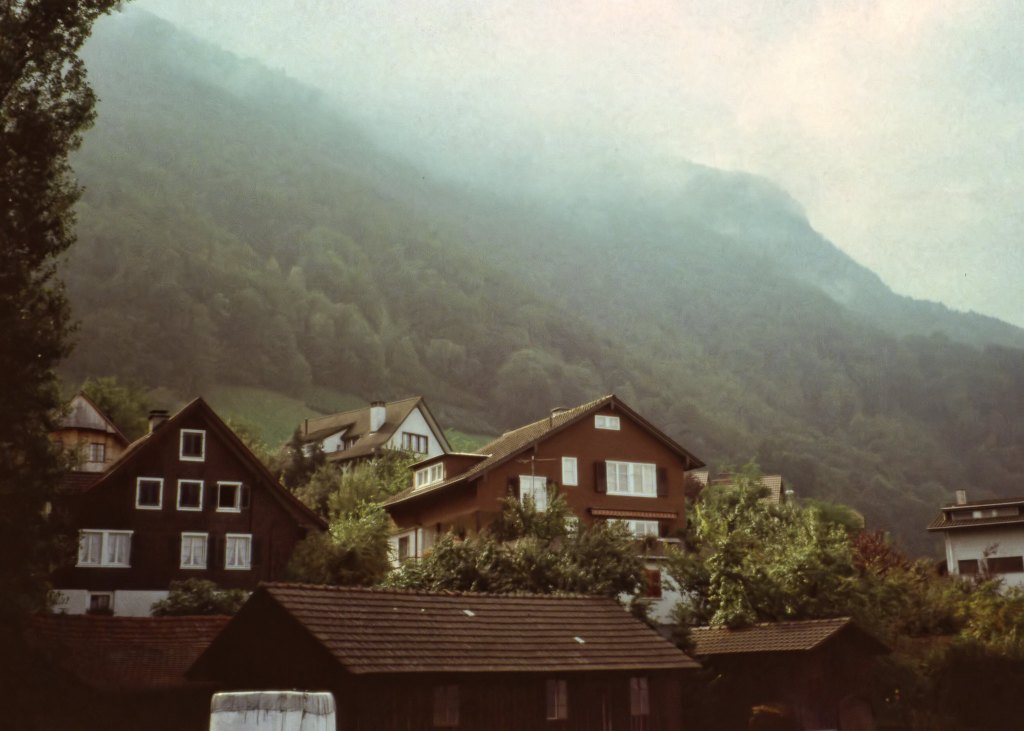
The next morning, as we headed out on a ferry that took us to the base of Mt. Pilatus, we saw Swiss chateaus hiding in the thick fog just up from the lakeshore. Cowbells could be heard somewhere in the mist (English definition, here.) The green hillsides were shrouded in mystery. Once we got to the train station at the base of the mountain, the sun was out, but the top of the mountain was still hidden from view. For the next half hour, the single-car train slowly crawled up the side of the mountain. It is the steepest cog railway in the world and gives passengers plenty of time to enjoy some pretty amazing Swiss Alp views. And cows. Lots of cows.
Until we got to the top. There, the fog was still thick around the summit, giving only the briefest glimpses of the lake below. Trails weaved off into the impenetrable fog. People hiked off into the unknown, apparently far more adventurous than we were.
The return trip was via a cable car that passed over small Swiss farms and large Swiss cows that plucked the grass along the steep hills. It was, all in all, pretty idyllic. Even if it was foggy.
##
Despite the name, most of Oktoberfest is actually held in September, and we would be going in the company of one Doctor Peter Höflich. No, my host dad in family #2 hadn’t finished an advanced degree in the couple of months since I had been there. It was a bit of a ruse. Turns out, when a city holds what is arguably the world’s biggest beer party, a lot of people show up. And apparently, they don’t all sleep in train stations or youth hostels. Hotel rooms for miles around are booked solid. So Peter called in a favor and got us lodging at the Max Planck Institute. As the lodging is supposed to be only for visiting academicians, Peter was given an honorary, if not temporary, title of Doctor. He was excellent at making wine, so I don’t think a Doctorate in Wine is out of the question.
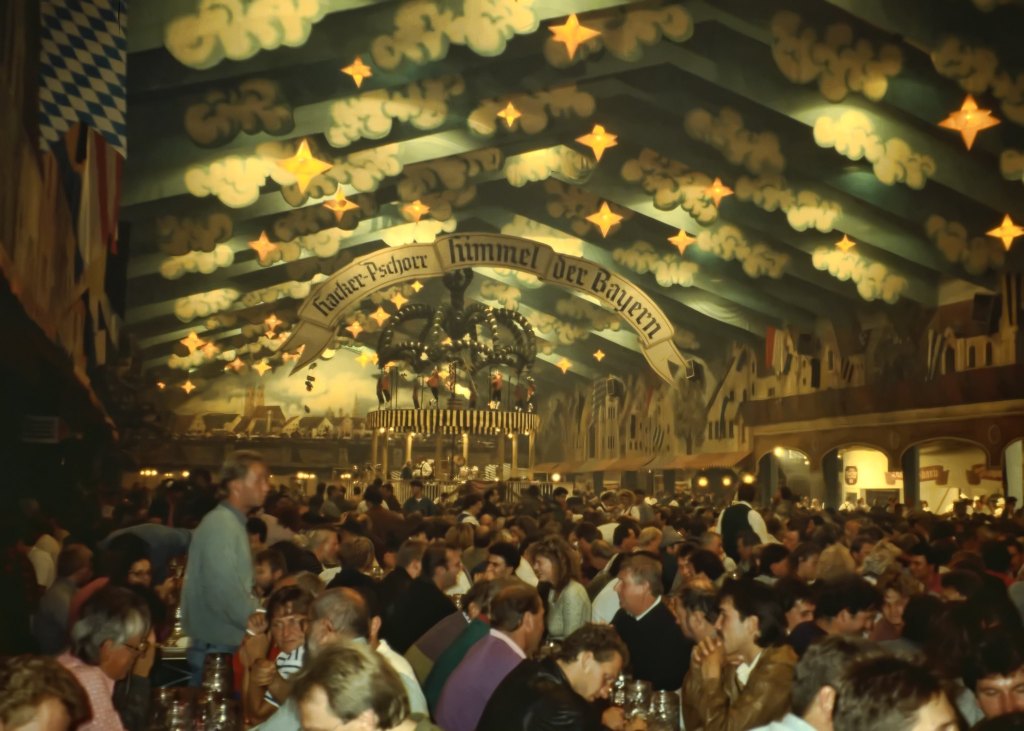
What’s Oktoberfest like? Think of the largest town festival you have been to. Now multiply it. How many times? It doesn’t matter. You’ll still be thinking too small. The festival grounds were roughly the size of a typical small Midwestern town. On top of that, throw in two-thirds of an amusement park, say your local Six Flags. Now you start to see what this was like. One beer “tent” alone could hold 5,000 people at once, with room left for a good-sized band. At least one of these beer tents is actually a permanent building.
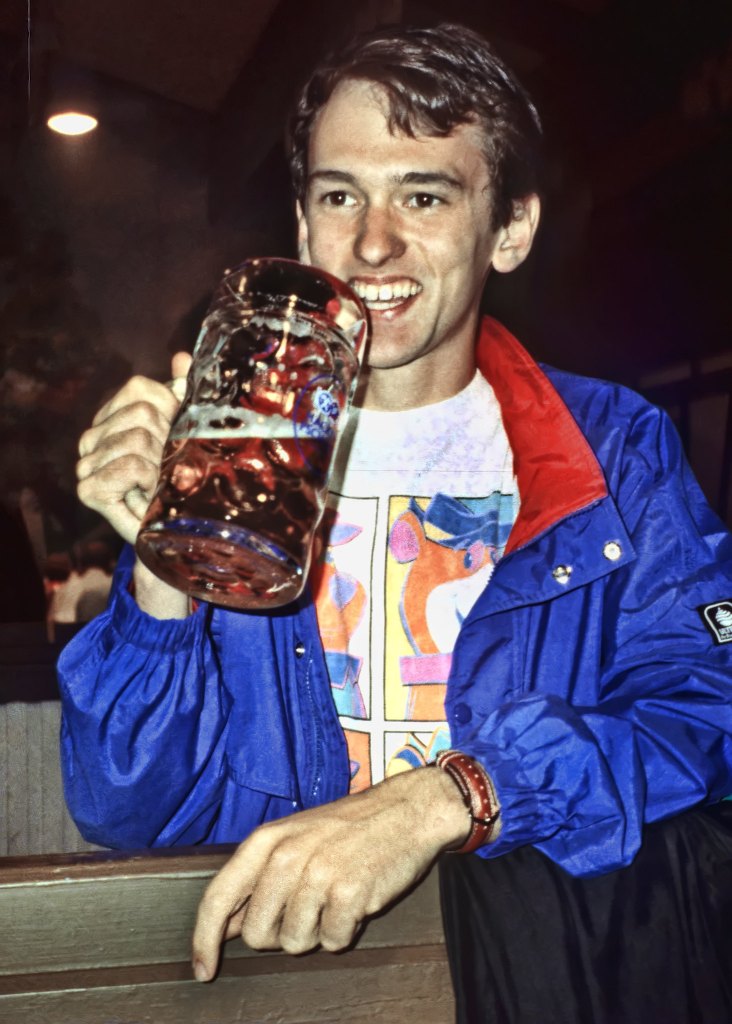
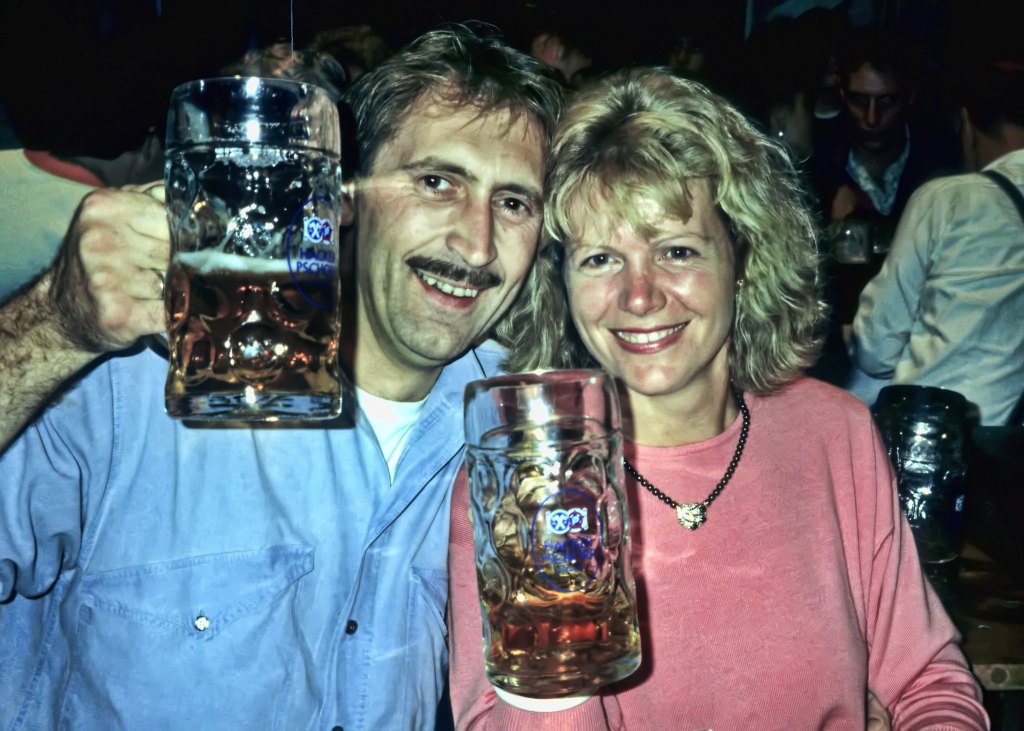
Oktoberfest is known for beer. So much so, in fact, that they serve it in liter glasses (or steins). And, naturally, the Höflichs thought I really should get the hang of German beer and bought me a whole liter. This was Octoberfest, after all.
It was now or never. I would like beer or I wouldn’t. I would drink or I wouldn’t.
I didn’t.
Now that liter of Coca-Cola looked good. I’ll take one of those, please. I did pose briefly with a half-full liter of beer and a smile on my face as if I had really enjoyed that first gulp.
The evening was a blur, even just drinking Coke. The rides twisted and spun in neon streaks all around us. Bands played music that ran into one long polka. (Were they all playing the same song?) People sang along in whatever language they wanted to. A lot of people did that very dangerous sort of dancing that somehow, amazingly, didn’t end up with a ride in an ambulance. It started to rain. No one cared. There were so many people the rain couldn’t hit the ground. At some point, we packed ourselves onto a Munich U-Bahn train and headed back to the Max Planck Institute. I think we slept before returning to Großostheim the next day.
##
A few days later, we passed back through the Frankfurt Hauptbahnhof, heading north, way north, to our next-to-last host families. In about a month and a half, we would all come back to Frankfurt, but to the airport for the flight home.
These six months were going fast. Sometimes not fast enough and others times too fast.
 One Guy's Writings
Flexibility is the key.
LikeLike